

From Synopsis to Defence: A Step-by-Step PhD Thesis Roadmap
Map each synopsis objective to a thesis chapter and a paper, stay within UGC plagiarism limits (10% or less, no penalty) and prepare for your open defence.
Most PhD delays do not happen in the laboratory. They happen at the joins: between a synopsis and the first experiment, between results and a journal paper, and between the final draft and a plagiarism report that comes back too high.
This roadmap connects every stage. Its core tool is a simple table that links each synopsis objective to a thesis chapter and a journal paper. Plan this link on day one and your thesis almost writes itself. We also cover the UGC plagiarism levels and how to prepare for your open defence.
The roadmap at a glance
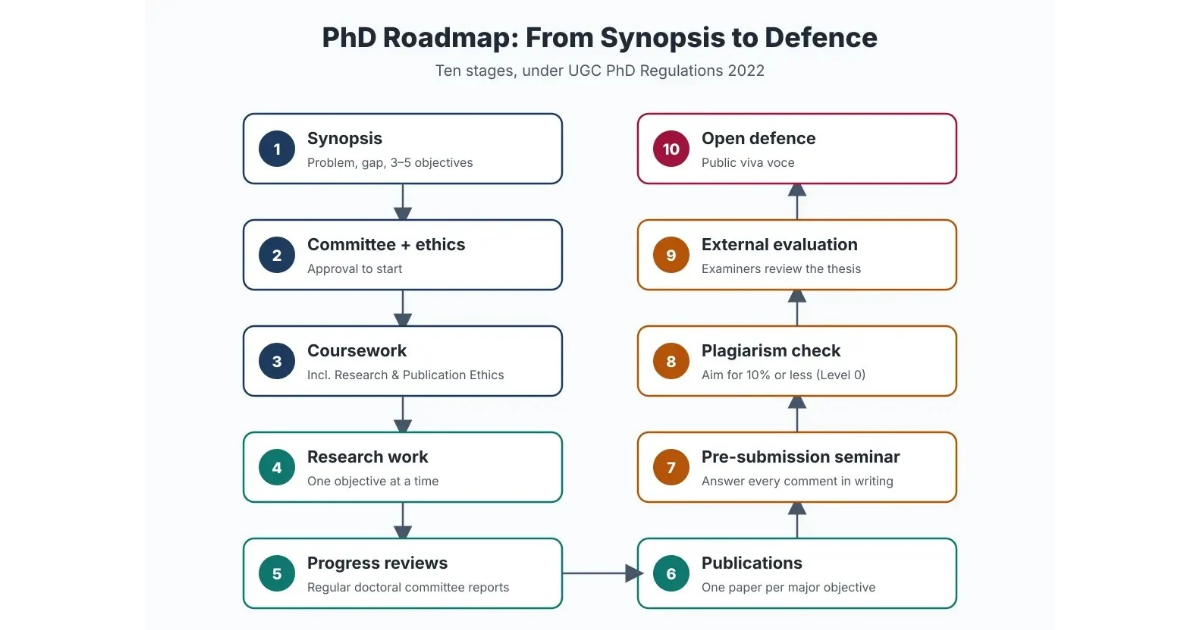
- Synopsis: Define the problem, gap, objectives and methods.
- Committee and ethics approval: Present to your research committee and obtain ethics clearance.
- Coursework: Complete pre-PhD coursework, including the compulsory Research and Publication Ethics course.
- Research work: Collect data objective by objective.
- Progress reviews: Report to your doctoral committee regularly.
- Publications: Publish one paper per major objective.
- Pre-submission seminar: Present the complete work to your department.
- Plagiarism check and submission: Check similarity, then submit.
- External evaluation: Examiners review the thesis.
- Open defence: Defend your thesis in a public viva voce.
Step 1: Write a synopsis built for the thesis
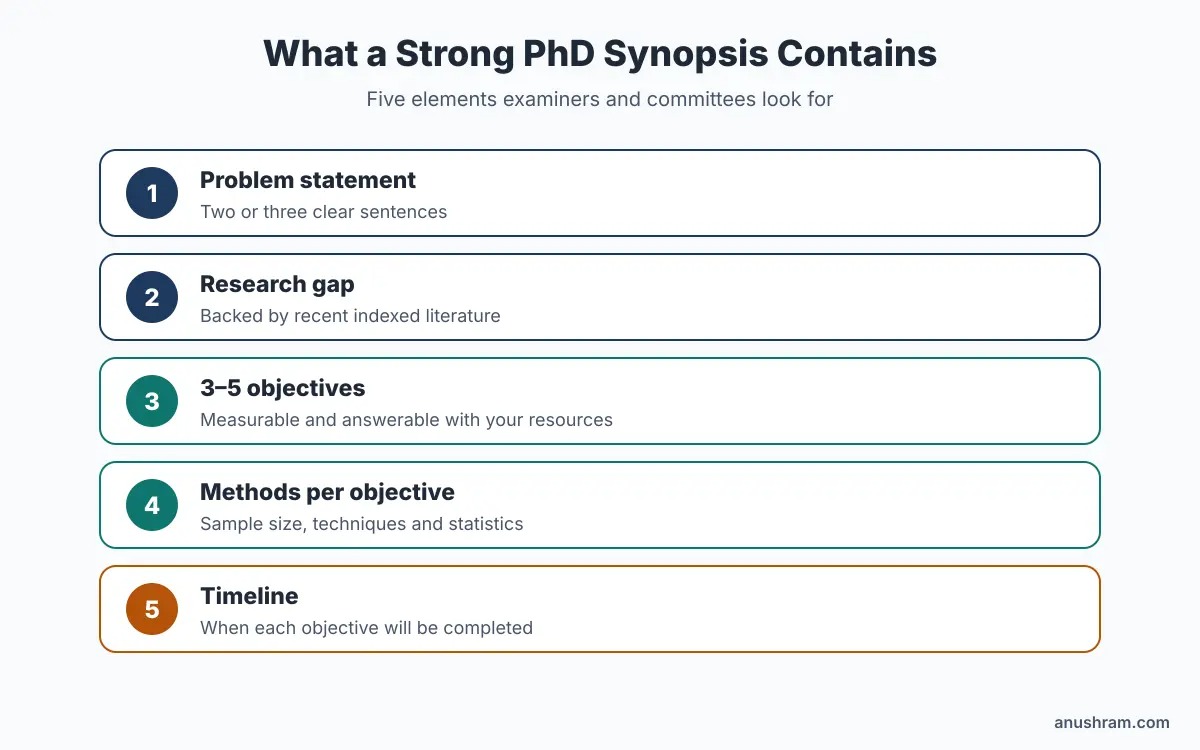
A synopsis is not just a permission document. It is the blueprint of your thesis. A strong synopsis has:
- A clear problem statement in two or three sentences
- A specific research gap, supported by recent indexed literature
- Three to five objectives, each measurable and each answerable with your resources
- Methods for each objective, including sample size and statistics
- A timeline showing when each objective will be completed
Still choosing a topic? Use the 7-point topic test in our guide to PhD pathology research topics for 2026.
Step 2: Map each objective to a chapter and a paper
This is the most useful planning step most scholars skip. Here is a worked example for a pathology PhD on HER2-low breast cancer:
| Synopsis objective | Thesis chapter | Journal paper |
| Background and research gap | Ch 1: Introduction; Ch 2: Review of literature | Paper 0 (optional): review article |
| All methods | Ch 3: Materials and methods | Methods sections of Papers 1–3 |
| O1: Find the prevalence of HER2-low breast carcinoma | Ch 4: Results I | Paper 1: cross-sectional study |
| O2: Link HER2-low status with clinicopathological features | Ch 5: Results II | Combined with Paper 1, or a short communication |
| O3: Compare digital and manual HER2 scoring | Ch 6: Results III | Paper 2: diagnostic agreement study |
| O4: Study the link between HER2-low status and outcome | Ch 7: Results IV | Paper 3: cohort study |
| Synthesis of all objectives | Ch 8: Discussion, summary and conclusions | Future work; conference presentation |
[Image: phd-objective-chapter-paper-map.webp]
Why this works:
- Examiners see a coherent story. Each chapter answers one objective from the synopsis.
- Publication requirements are met early. You publish as you go rather than rushing at the end.
- Plagiarism is easier to manage. Many universities let you exclude your own published papers from the similarity check. Confirm your university’s rule.
Want your objectives mapped to chapters and papers? Send us your draft synopsis and we will build the plan with you. Book a free synopsis review →
Step 3: Complete coursework, including the ethics course
UGC requires every PhD scholar to complete a two-credit course on Research and Publication Ethics as part of pre-registration coursework. Take it seriously. It covers the same issues your examiners will look for: data integrity, image manipulation, authorship and predatory journals.
Step 4: Do the research and report progress
Work one objective at a time. After each one, write up the results while they are fresh. A results chapter written within a month of the analysis is far better than one written two years later from memory. Keep a single, clean master data file and a log of every change.
Step 5: Stay within UGC plagiarism levels
The UGC plagiarism regulations of 2018 define four levels of similarity for theses and dissertations:
[Image: ugc-plagiarism-levels-phd-thesis.webp]
| Level | Similarity | Consequence for a thesis |
| Level 0 | Up to 10% | Minor similarity: no penalty |
| Level 1 | Above 10% to 40% | Revised thesis to be submitted within 6 months |
| Level 2 | Above 40% to 60% | Debarred from submitting a revised thesis for 1 year |
| Level 3 | Above 60% | Registration for the programme cancelled |
The official wording is: Level 0: Similarities upto 10% - Minor Similarities, no penalty. Level 1: Similarities above 10% to 40% - Such a scholar shall be asked to submit a revised script within a stipulated time period not exceeding 6 months. At the top level, Level 3: Similarities above 60% -Such scholar’s registration for that programme shall be cancelled. efluniversityefluniversity
The regulations also exclude some content from the check: quoted work that is reproduced with the necessary permission or attribution; references, bibliography, table of contents, preface, and acknowledgements; generic terms, laws, standard symbols, and standard equations; common knowledge or coincidental terms, up to fourteen consecutive words. ssrana
Aim for Level 0. Some universities set stricter limits of their own. Practical tips:
- Write the review of literature from your own notes, not by editing source paragraphs.
- Run a check after each chapter, not only on the full thesis.
- Ask the library to exclude your own published papers where your university allows it.
- Never use AI tools or paraphrasing software to disguise copied text. Examiners and software increasingly detect it, and it is still plagiarism.
Step 6: Pre-submission seminar and submission
Present your complete work to the department and doctoral committee. Answer every suggestion in writing and show where you made each change. Then finalise formatting, run the final plagiarism check and submit. For a formatting example, see our NIT Durgapur thesis format guide.
Step 7: Prepare for the open defence
Under the UGC PhD Regulations 2022, if the evaluation of the submission is satisfactory, the candidate will have to defend the thesis in a public viva voce. Faculty, fellow scholars and other interested people may attend and ask questions. legacyias
How to prepare:
- Build a 30–40 minute talk organised around your objectives, using the same structure as your mapping table.
- Read the examiners’ reports and prepare a clear answer to every comment.
- Practise “why” questions: Why this sample size? Why this method? Why not a control group?
- Know your limitations and say them before someone else does.
- Hold a mock defence with colleagues who have not seen your work.
If you are a medical scholar deciding between routes, our comparison of PhD in Pathology vs MD thesis explains how the open defence differs from the MD viva.
Five common mistakes between synopsis and defence
- Changing objectives without approval. If your research changes direction, record the change formally with your committee. Examiners compare your thesis with the approved synopsis.
- Writing every chapter at the end. This creates inconsistent results and a rushed discussion. Write as you go.
- Publishing in unindexed or predatory journals. Such papers may not count, and they can harm your credibility at the defence.
- Ignoring your university’s thesis format. Follow its template from the first draft, not the last week.
- Treating the viva as a formality. An open defence is public. Prepare as carefully as you did for your synopsis presentation.
How Anushram can help
We help scholars plan and present their own research clearly. We do not replace it. Scholars work with us on:
- Synopsis structuring and objective mapping for a PhD thesis
- Chapter planning, language editing and formatting through our thesis assistance services
- Turning chapters into journal papers
- Similarity checks and guidance on reducing similarity by genuine rewriting
- Mock open defences through our training programmes
Always keep your supervisor informed about any outside guidance you receive.
Frequently asked questions
Q1. What is the plagiarism limit for a PhD thesis under UGC rules?
Similarity up to 10% (Level 0) carries no penalty. Above 10% to 40% requires a revised thesis within six months. Above 40% to 60% bars you from resubmitting for one year. Above 60% leads to cancellation of registration. Individual universities may set stricter limits.
Q2. What is excluded from the plagiarism check?
Properly attributed quotations; references, bibliography, table of contents, preface and acknowledgements; generic terms, laws, standard symbols and equations; and common phrases of up to fourteen consecutive words.
Q3. What happens in a PhD open defence?
After the external examiners find the thesis satisfactory, you present and defend your work in a public viva voce that faculty, scholars and other interested people can attend.
Q4. How many objectives should a PhD synopsis have?
Most strong synopses have three to five objectives. Each objective should lead to a results chapter and, ideally, a journal paper.
Plan your thesis from synopsis to defence
One planning session can save you a year of rework. Bring your synopsis or draft chapters.
Book your free consultation → | See pricing | Call or WhatsApp: +91 96438 02216
