

Most M.Tech CSE students know their code well but struggle to turn it into a well-structured thesis and dissertation. What goes in Chapter 3 and what goes in Chapter 4? How long should the literature review be? Where do you put the code? How do you present results so examiners are convinced? A clear chapter structure answers all of these questions and makes writing much faster.
This Anushram guide walks you through every part of an M.Tech CSE thesis and dissertation: the front matter, each of the six main chapters, and the back matter. For every chapter you will see what to include, sample headings using an illustrative intrusion detection project, and common mistakes. You will also see the best order to write the chapters, formatting tips, and how Anushram helps you with chapter-by-chapter feedback.
In short: a typical M.Tech CSE thesis and dissertation has front matter, six chapters (introduction, literature review, proposed methodology, implementation, results and discussion, conclusion and future work) and back matter (references, appendices, publications). Write results first and the introduction last, and always follow your university's own format.
The structure at a glance
Front matter, six chapters and back matter. Your university's format comes first.
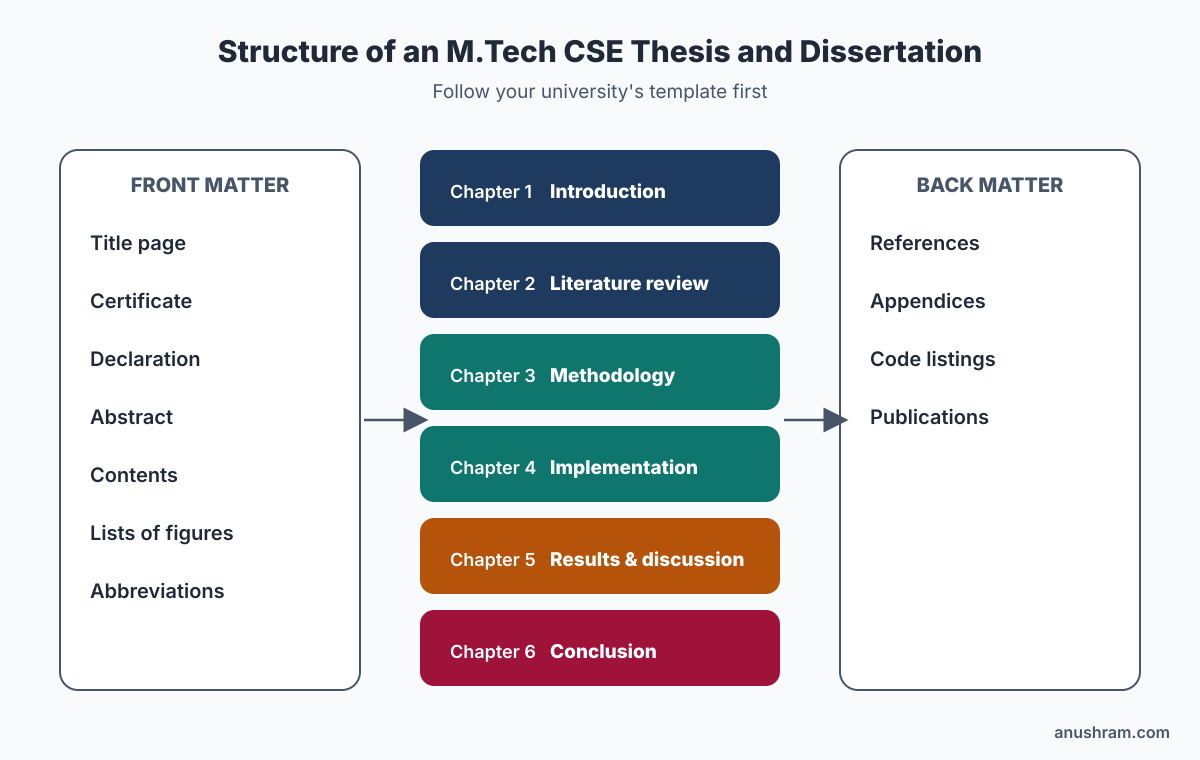
| Part | Contents | Typical length |
| Front matter | Title page, certificate, declaration, acknowledgements, abstract, contents, lists of figures, tables and abbreviations | 8 to 12 pages |
| Chapter 1 | Introduction | 5 to 8 pages |
| Chapter 2 | Literature review | 10 to 15 pages |
| Chapter 3 | Proposed methodology | 10 to 15 pages |
| Chapter 4 | Implementation | 10 to 15 pages |
| Chapter 5 | Results and discussion | 15 to 20 pages |
| Chapter 6 | Conclusion and future work | 3 to 6 pages |
| Back matter | References, appendices, list of publications | Varies |
Lengths are illustrative. Some universities combine methodology and implementation, or results and conclusion. Always check your department's template first.
Front matter: small pages, big first impression
- Title page, certificate and declaration: use your university's exact wording and signatures.
- Abstract: 250 to 350 words covering the problem, gap, method, dataset, key quantified results and conclusion. Examiners often read this first.
- Lists of figures, tables and abbreviations: generate them automatically in Word or LaTeX so numbering stays correct.
An illustrative abstract structure
A strong abstract follows a simple pattern. For the illustrative IDS project it could run: one sentence on why IoT networks need lightweight intrusion detection; one sentence on the gap, that accurate deep models are too heavy for edge devices; two sentences on the proposed method and the public dataset used; two sentences giving the main results with numbers, compared against named baselines; and one closing sentence on what this means for real deployments. Write it last, keep it to one paragraph, and make sure every number matches your results chapter.
Chapter 1: Introduction
The introduction tells the examiner why your work matters and exactly what you did.
- Background and motivation for the problem
- A clear problem statement
- Two to four numbered objectives
- Your contributions, stated specifically
- Scope and limitations
- An outline of the remaining chapters
Sample headings (illustrative IDS project): 1.1 Background: intrusion detection in IoT networks; 1.2 Problem statement; 1.3 Objectives; 1.4 Contributions; 1.5 Scope; 1.6 Organisation of the dissertation.
Chapter 2: Literature review
This chapter proves you know the field and shows where the gap lies.
- Organise by theme or approach, not paper by paper.
- Include a comparison table of key studies: method, dataset, metrics, results and limitations.
- End with a clear research gap that leads directly to your objectives.
Sample headings: 2.1 Traditional machine learning for intrusion detection; 2.2 Deep learning approaches; 2.3 Lightweight models for IoT devices; 2.4 Comparison of existing methods; 2.5 Research gap.
Our guide on how to identify a research gap shows how to write the final section well.
Chapter 3: Proposed methodology
Here you explain your approach in enough detail for another researcher to understand and repeat it.
- An overall architecture or flow diagram of the proposed system
- Dataset description and preprocessing steps
- The proposed model or algorithm, with equations or pseudocode
- Evaluation metrics and why you chose them
- Baseline methods you will compare against
Sample headings: 3.1 System architecture; 3.2 Dataset and preprocessing; 3.3 Feature selection; 3.4 Proposed lightweight model; 3.5 Evaluation metrics; 3.6 Baseline methods.
Chapter 4: Implementation
- Hardware and software environment, with library versions
- Data split or cross-validation strategy
- Hyperparameters and how you tuned them
- Key code modules described in prose, with short snippets only where they help
- Where full code is available, such as an appendix or repository
Avoid pasting pages of code into the chapter. Describe what the code does, and place longer listings in an appendix if your university allows.
Want chapter-by-chapter feedback on your M.Tech CSE thesis and dissertation? Book a free review with an Anushram CSE mentor. Book your free chapter review →
Chapter 5: Results and discussion
This is usually the most important chapter. Examiners look for fair comparisons and clear explanations.
Six parts of a convincing results chapter.
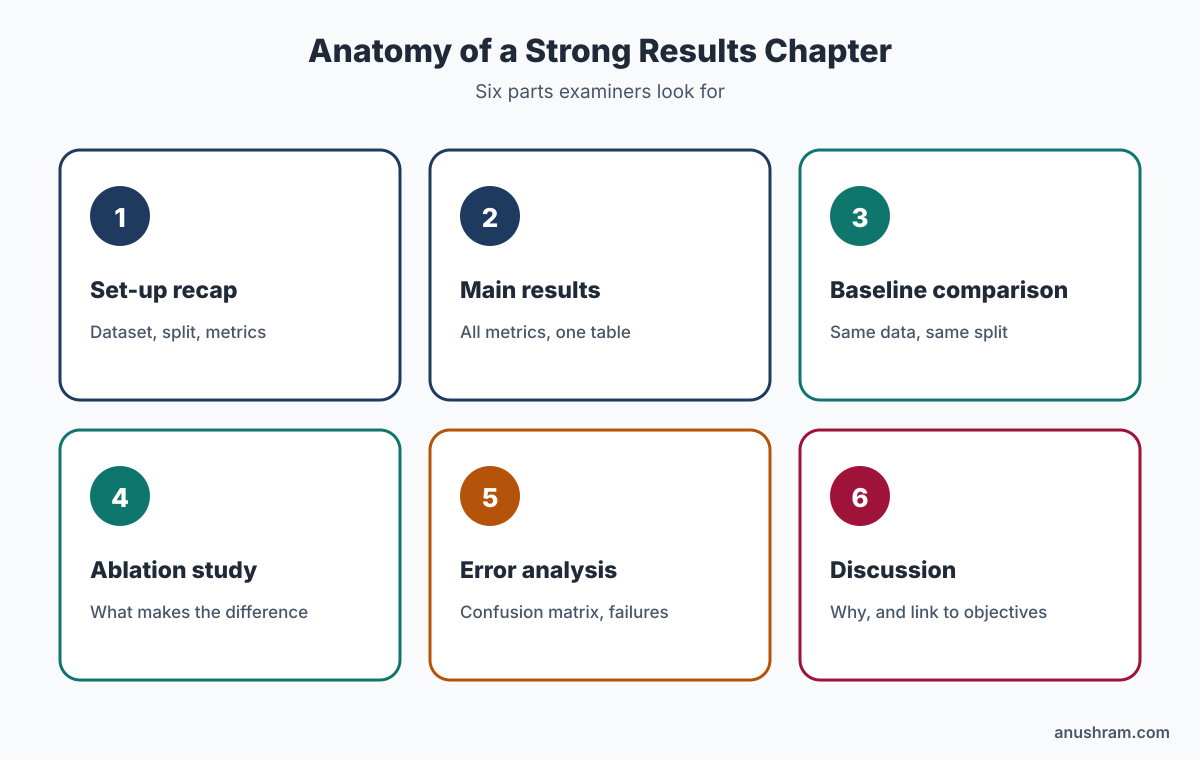
- Set-up recap: a short reminder of the dataset, split and metrics.
- Main results table: your method's performance on all metrics.
- Comparison with baselines: on the same data and split, with clear tables and charts.
- Ablation study: which components of your method make the difference.
- Error analysis: confusion matrices and examples where the model fails.
- Discussion: why the results look the way they do, and how they relate to your objectives.
Report precision, recall and F1-score alongside accuracy, especially for imbalanced data, and include mean and standard deviation where you repeated experiments.
Chapter 6: Conclusion and future work
- Answer each objective directly, with numbers.
- Summarise your main contributions.
- State limitations honestly.
- Suggest specific, realistic future work.
Do not introduce new results here, and keep the chapter short and precise.
Back matter: references and appendices
- References: CSE departments often use the IEEE citation style. IEEE's reference guide explains the format for journals, conferences, books and websites.[1] Use a reference manager to keep citations consistent.
- Appendices: extra results, longer code listings, configuration files and dataset details.
- List of publications: any paper accepted or submitted from your work.
The best order to write your chapters
Write from your strongest material outwards.
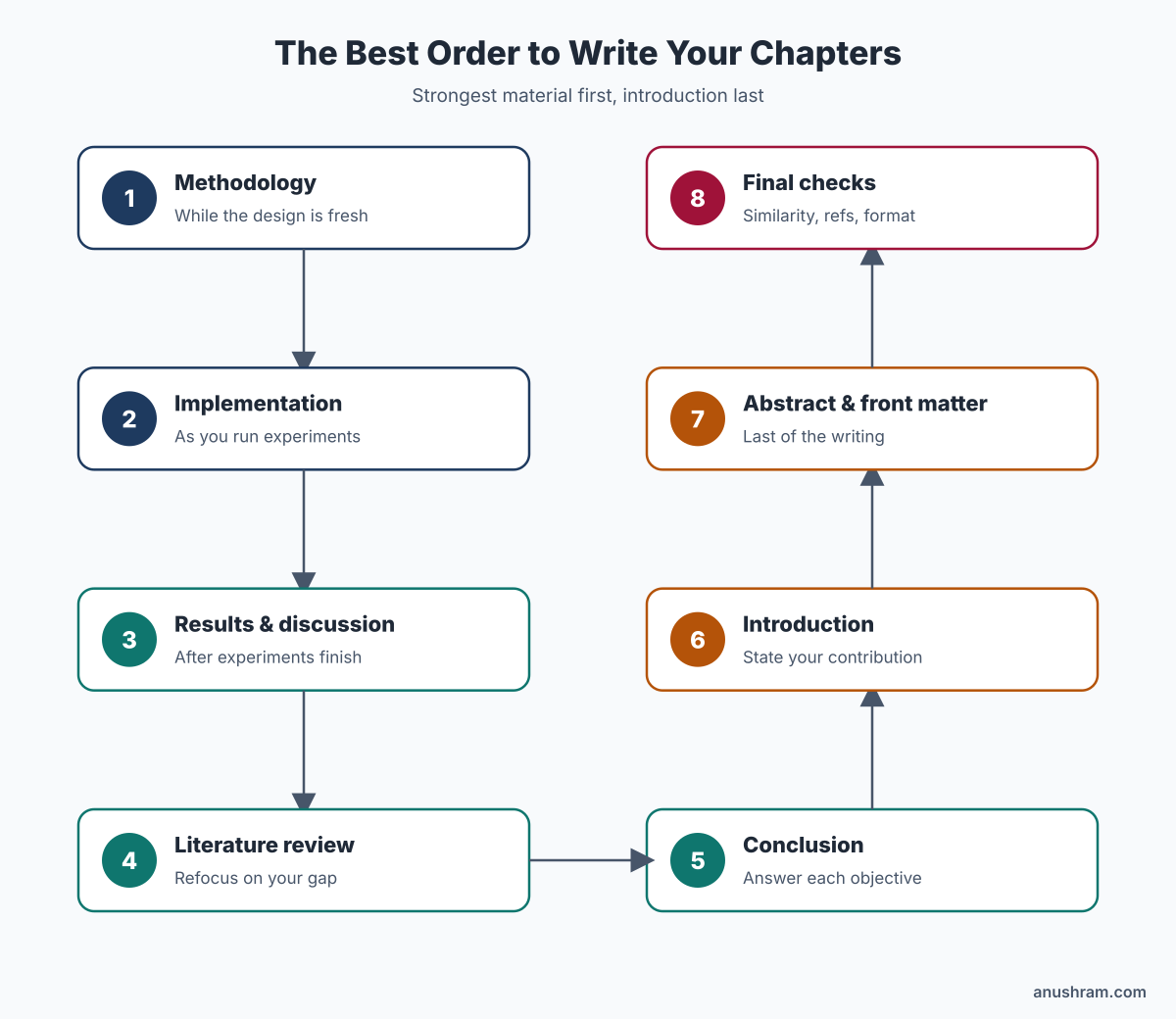
- Methodology, while your design is fresh in your mind
- Implementation, as you build and run experiments
- Results and discussion, once experiments are complete
- Literature review, updated to focus on your gap
- Conclusion, answering each objective
- Introduction, now that you know your contribution
- Abstract and front matter
- Final checks: similarity, references, numbering and format
Formatting tips: Word or LaTeX
- Use your university's template if one exists.
- LaTeX handles equations, numbering and references very well; Overleaf offers many university thesis templates you can start from.[2]
- In Word, use built-in heading styles, captions and cross-references so lists and numbering update automatically.
- Keep figures readable: large fonts, labelled axes and consistent colours.
Similarity and AI rules for every chapter
Under the UGC 2018 regulations, which apply to master's dissertations, similarity up to 10% carries no penalty and higher levels require revision.[3] The literature review is where most similarity problems start, so write every summary in your own words and cite each source. The Committee on Publication Ethics states that AI tools cannot be authors and that their use must be disclosed;[4] follow your university's AI policy in every chapter.
Common chapter mistakes
- A literature review that lists papers one by one with no comparison or gap
- Mixing methodology and results so the reader cannot follow
- Pages of raw code instead of clear explanation
- Results tables with no discussion of why
- A conclusion that repeats the abstract instead of answering the objectives
- Inconsistent reference styles
See also our guide to common thesis mistakes.
Why M.Tech students in India and abroad choose Anushram
What students value in Anushram's guidance.
Students value our CSE-specific mentors, online guidance that works for Indian and overseas universities, chapter-by-chapter feedback, help with code and results, a clear path to IEEE and Scopus papers, and transparent pricing. We guide; you write. Read why M.Tech students choose Anushram.
How Anushram helps with your chapters
- Chapter outlines tailored to your project and university format
- Written feedback on each chapter's structure, logic and clarity
- Results presentation advice: tables, charts and discussion
- Formatting and reference checks through our thesis assistance services
- LaTeX and Overleaf training
- Guidance on turning chapters into a paper through our research paper guidance
https://www.anushram.com/paper-writing
New to the full process? Start with our M.Tech CSE thesis and dissertation guidance, or choose a topic from our list of M.Tech CSE thesis and dissertation topics for 2026.
Frequently asked questions
Q1. How many chapters are in an M.Tech CSE thesis and dissertation?
Most have five or six chapters: introduction, literature review, methodology, implementation (sometimes combined with methodology), results and discussion, and conclusion. Follow your university's format.
Q2. How many pages should an M.Tech CSE dissertation be?
Many are around 60 to 100 pages including front and back matter, but universities set their own limits.
Q3. Should I include my code in the dissertation?
Describe the code in the implementation chapter and place longer listings in an appendix or a repository, if your university allows.
Q4. Which citation style should I use?
Many CSE departments use IEEE style, but always follow your university's guidelines.
Q5. Which chapter should I write first?
Many students find it easiest to start with methodology and implementation, then results, and write the introduction and abstract last.
Q6. Can Anushram review my chapters if I study abroad?
Yes. Our guidance is online, so students from universities in India and abroad can get chapter feedback.
Conclusion
A clear chapter structure turns months of coding and experiments into a thesis and dissertation that examiners can follow and trust. Use the six-chapter structure, put your strongest material in methodology, implementation and results, write in the recommended order, and follow your university's format. With chapter-by-chapter feedback, you can finish faster and defend your work with confidence.
Get your chapters right the first time
Get a free chapter review from an Anushram CSE mentor:
- Chapter outline matched to your university format
- Literature review structure and gap feedback
- Results chapter tables, charts and discussion advice
- Formatting and references checks
We guide you; your thesis stays your own. Students from India and abroad welcome.
Book your free chapter review →
Or explore thesis guidance · See pricing · Call or WhatsApp: +91 96438 02216


