

Choosing the right topic is the most important decision in your M.Tech CSE thesis and dissertation. A good topic has a real research gap, a public dataset you can actually use, and results that can be compared with published work. A weak topic leads to months of confusion, a thin results chapter and a nervous viva.
This Anushram list gives you 50 M.Tech CSE thesis and dissertation topics for 2026, grouped into eight research areas. Every topic comes with a real public dataset or resource and the usual tools, so you can judge quickly whether it suits your skills, time and computing resources. You will also find a six-point test to check any topic, ways to make a standard topic original, and a six-step path from idea to approved proposal.
How to use this list: shortlist three topics from areas you enjoy, check each against the six-point test, confirm that the dataset is available and your hardware can handle it, then discuss the shortlist with your guide. Narrow the final topic to one clear problem before you start coding.
How the 50 topics in this list are spread across eight areas.
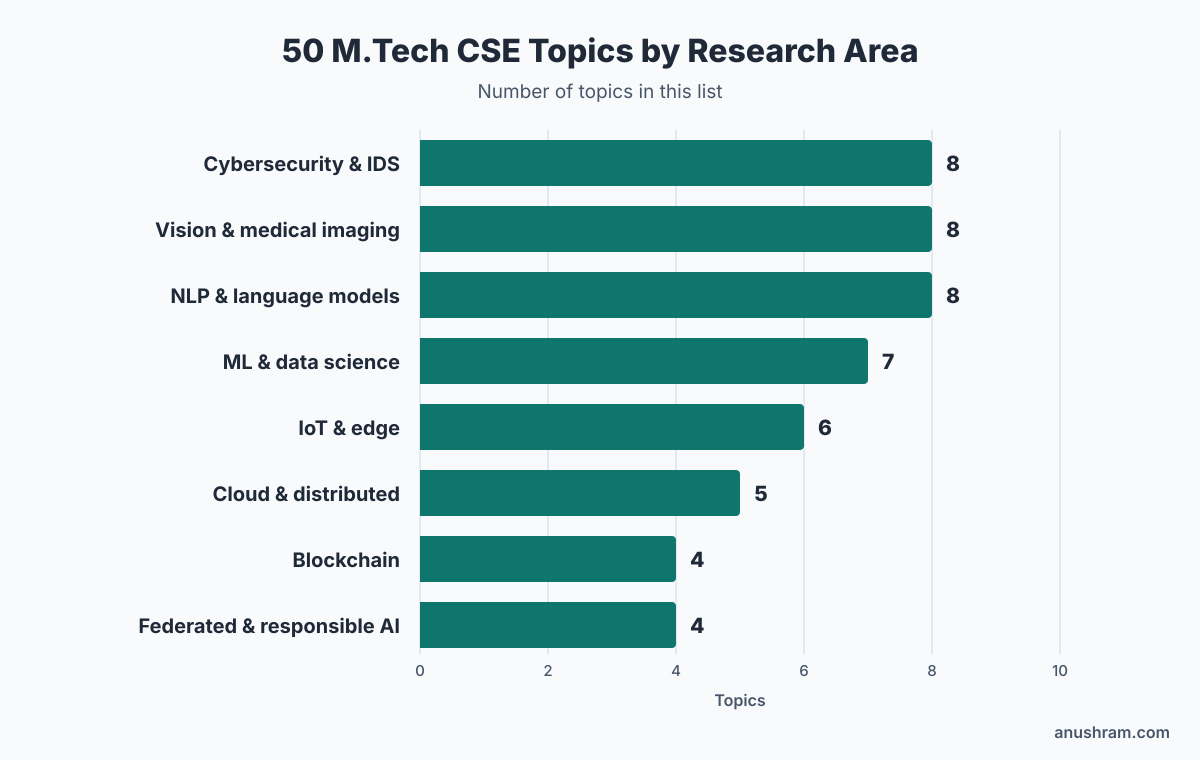
1. Cybersecurity and intrusion detection (8 topics)
| # | Topic | Dataset or resource | Tools |
| 1 | Lightweight deep learning intrusion detection for IoT networks | CIC-IoT2023, N-BaIoT | Python, TensorFlow |
| 2 | Feature selection to reduce false alarms in network intrusion detection | CIC-IDS2017, NSL-KDD | scikit-learn |
| 3 | Explainable intrusion detection using SHAP | UNSW-NB15 | Python, SHAP |
| 4 | DDoS attack detection in software-defined networks | CICDDoS2019 | Mininet, Python |
| 5 | Phishing website detection from URL and page features | UCI phishing websites data | scikit-learn, XGBoost |
| 6 | Android malware detection using permission and API features | CIC-AndMal2017 | Python, PyTorch |
| 7 | Handling class imbalance in botnet detection | Bot-IoT | imbalanced-learn |
| 8 | Adversarial robustness of ML-based intrusion detectors | NSL-KDD | Adversarial Robustness Toolbox |
2. Computer vision and medical imaging (8 topics)
| # | Topic | Dataset or resource | Tools |
| 9 | Skin lesion classification with lightweight CNNs | HAM10000 | PyTorch |
| 10 | Chest X-ray disease classification with attention models | NIH ChestX-ray14 | PyTorch |
| 11 | Brain tumour segmentation using U-Net variants | BraTS | PyTorch, MONAI |
| 12 | Plant disease detection for mobile devices | PlantVillage | TensorFlow Lite |
| 13 | Facial expression recognition under low light | FER2013 | OpenCV, PyTorch |
| 14 | Small object detection in traffic scenes | COCO, Cityscapes | YOLO, PyTorch |
| 15 | Data-efficient image classification with self-supervised learning | CIFAR-10 | PyTorch |
| 16 | Vision transformer versus CNN for limited medical data | HAM10000 | PyTorch, timm |
3. Natural language processing and language models (8 topics)
| # | Topic | Dataset or resource | Tools |
| 17 | Fake news detection with transformer models | LIAR | Hugging Face Transformers |
| 18 | Sentiment analysis for Indian languages | AI4Bharat IndicNLP resources | IndicBERT, Transformers |
| 19 | Hate speech detection in code-mixed text | HASOC shared task data | Transformers |
| 20 | Abstractive news summarisation with small language models | CNN/DailyMail | Transformers |
| 21 | Question answering with retrieval-augmented generation | SQuAD | Transformers, FAISS |
| 22 | Topic classification with limited labels | AG News | scikit-learn, Transformers |
| 23 | Detecting AI-generated text | Public human-versus-AI text sets | Transformers |
| 24 | Efficient fine-tuning of language models with LoRA | IMDB reviews | PEFT, Transformers |
4. Machine learning and data science (7 topics)
| # | Topic | Dataset or resource | Tools |
| 25 | Explainable heart disease prediction | UCI Heart Disease | scikit-learn, SHAP |
| 26 | Diabetes prediction with ensemble learning | Pima Indians Diabetes | XGBoost, LightGBM |
| 27 | Credit card fraud detection with imbalanced data | Public credit card fraud data (Kaggle) | imbalanced-learn |
| 28 | Remaining useful life prediction for aircraft engines | NASA C-MAPSS | PyTorch, LSTM |
| 29 | Short-term electricity load forecasting | UCI ElectricityLoadDiagrams | Python, Prophet, LSTM |
| 30 | Recommender systems with graph neural networks | MovieLens | PyTorch Geometric |
| 31 | Credit default prediction with fairness checks | UCI Default of Credit Card Clients | scikit-learn, Fairlearn |
5. IoT and edge computing (6 topics)
| # | Topic | Dataset or resource | Tools |
| 32 | Human activity recognition on edge devices | UCI Human Activity Recognition | TensorFlow Lite |
| 33 | Anomaly detection in IoT sensor streams | Intel Berkeley Lab sensor data | Python |
| 34 | Energy-aware task offloading in fog computing | Simulation | iFogSim |
| 35 | Smart home activity prediction | CASAS smart home data | Python, LSTM |
| 36 | TinyML keyword spotting on microcontrollers | Google Speech Commands | TensorFlow Lite Micro |
| 37 | IoT botnet detection at the network edge | N-BaIoT | Python, Raspberry Pi |
6. Cloud and distributed computing (5 topics)
| # | Topic | Dataset or resource | Tools |
| 38 | Deep reinforcement learning for cloud task scheduling | Simulation with public workload traces | CloudSim, Python |
| 39 | Workload prediction for auto-scaling | Google cluster traces | Python, LSTM |
| 40 | Energy-efficient virtual machine placement | Simulation | CloudSim |
| 41 | Anomaly detection in microservice logs | Public log datasets (Loghub) | Python |
| 42 | Container scheduling in Kubernetes clusters | Alibaba cluster trace | Python, Kubernetes |
7. Blockchain (4 topics)
| # | Topic | Dataset or resource | Tools |
| 43 | Blockchain-based secure health record sharing | Prototype on a test network | Hyperledger Fabric |
| 44 | Illicit transaction detection with graph learning | Elliptic Bitcoin dataset | PyTorch Geometric |
| 45 | Smart contract vulnerability detection | Public smart contract benchmarks | Solidity, Python |
| 46 | Lightweight consensus for IoT blockchains | Simulation | Python |
8. Federated learning, privacy and responsible AI (4 topics)
| # | Topic | Dataset or resource | Tools |
| 47 | Federated learning with non-identical client data | LEAF benchmark (FEMNIST) | Flower, PyTorch |
| 48 | Differential privacy in medical image classification | HAM10000 | Opacus |
| 49 | Bias detection and mitigation in income prediction | UCI Adult | Fairlearn, AIF360 |
| 50 | Communication-efficient federated learning for edge devices | CIFAR-10 (partitioned) | Flower |
Dataset names are given as starting points. Before you commit, open the official source, check the licence and citation instructions, and confirm the size fits your hardware. Many standard datasets are available through the UCI Machine Learning Repository[1] and the Canadian Institute for Cybersecurity,[2] while image benchmarks such as CIFAR-10 come from their original research groups[3] and Indian-language resources from initiatives such as AI4Bharat.[4]
Found two or three topics you like? Send them to an Anushram CSE mentor for a free topic review. We will check the gap, dataset and scope, and help you pick the strongest. Get a free topic review →
The six-point topic test
A topic should pass all six checks before you start.
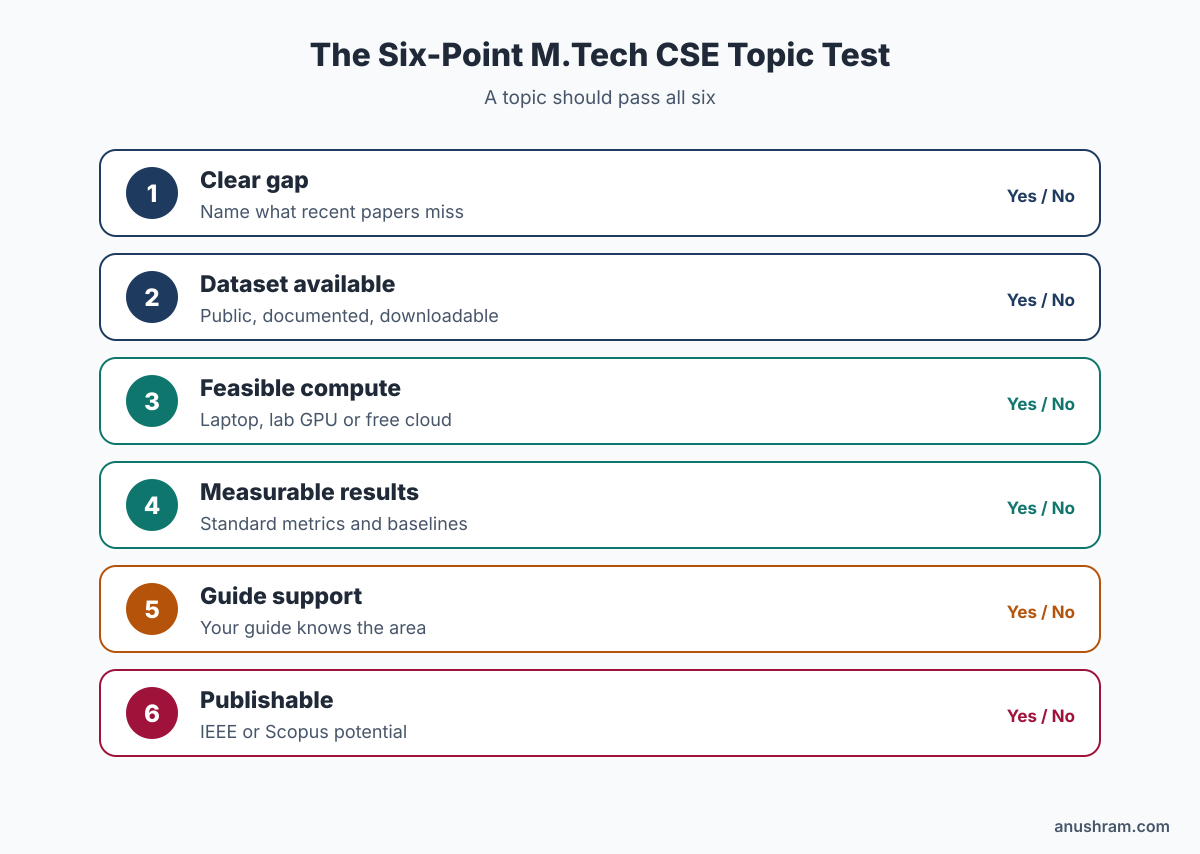
- Clear gap: can you name what recent papers do not do well?
- Dataset available: is there a public, documented dataset you can download today?
- Feasible compute: can your laptop, lab machine or free cloud credits train the models in time?
- Measurable results: are there standard metrics and baselines to compare against?
- Guide support: does your guide work in or understand this area?
- Publishable: could the result become an IEEE conference or Scopus-indexed paper?
Five ways to make a standard topic original
- Change the setting: apply a known method to a new domain, language or device, such as Indian languages or edge hardware.
- Add a constraint: make the model lighter, faster, more private or more energy-efficient.
- Add explainability: show why a model decides, using SHAP, LIME or attention maps.
- Test robustness: study performance under noise, imbalance, adversarial attacks or domain shift.
- Combine two methods in a well-justified hybrid and compare it fairly with each method alone.
From topic idea to approved proposal: 6 steps
The path from shortlist to an approved proposal.
- Shortlist three topics from this list or your own ideas.
- Read 10 recent papers on each and note their datasets, methods and results.
- Check the dataset and compute by running a quick baseline.
- Choose one topic and write a one-paragraph gap statement.
- Draft the proposal: problem, objectives, dataset, method, metrics and timeline.
- Get your guide's approval and refine based on feedback.
For the full process after approval, read our M.Tech CSE thesis and dissertation guidance. Our guide on identifying a research gap also applies to M.Tech work.
Topics to avoid
- Very broad titles such as "Machine learning in healthcare" with no specific problem.
- Topics needing private data you cannot get, such as hospital records without approvals.
- Training very large models from scratch without the computing resources.
- Exact copies of a published paper with no change in setting, method or analysis.
- Pure software development projects with no research question or comparison.
Why M.Tech students in India and abroad choose Anushram
What students value in Anushram's guidance.
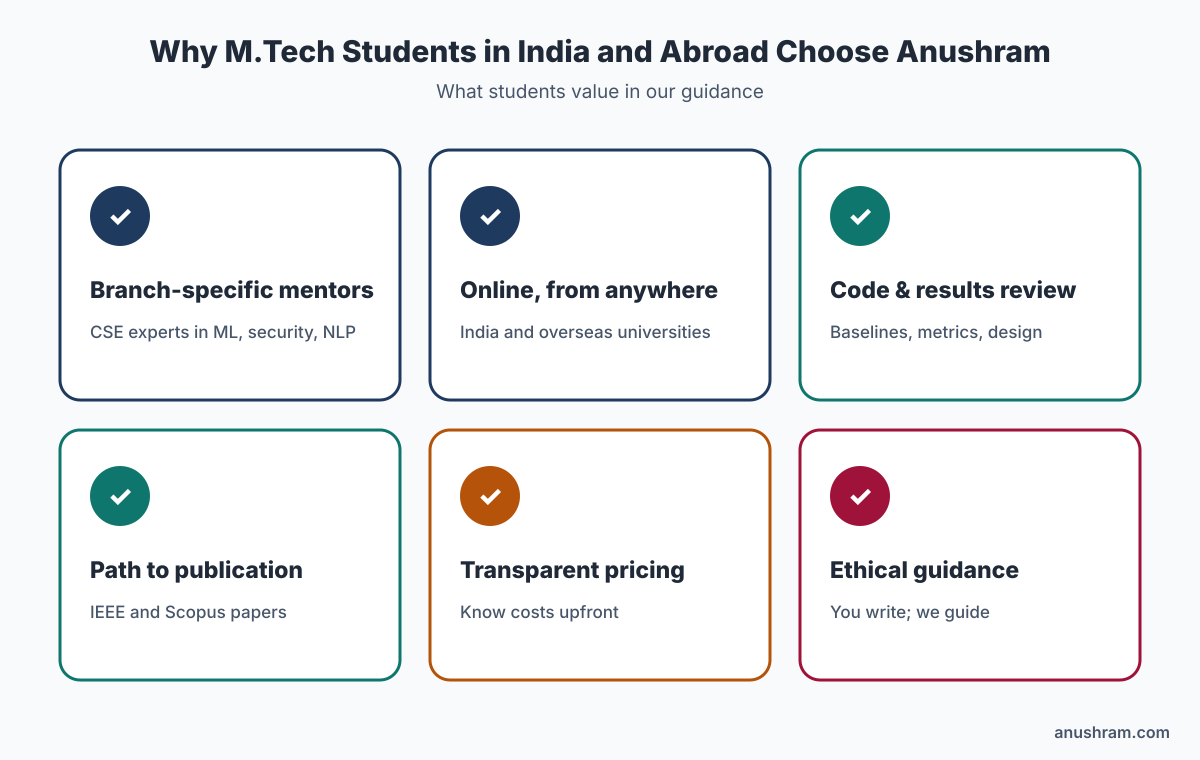
Students come to Anushram because they get CSE-specific mentors, online guidance from anywhere, honest feedback on code and results, and a clear path to an IEEE or Scopus paper, with transparent pricing. We guide; you research and write. Read more about why M.Tech students choose Anushram.
How Anushram helps with your topic and beyond
- Topic shortlisting and gap analysis
- Dataset and baseline selection
- Proposal review before submission to your guide
- Implementation and results feedback through our thesis assistance services
- Training in Python, PyTorch, TensorFlow and LaTeX
- Turning your dissertation into a paper through our research paper guidance. Our upcoming guide to an M.Tech CSE research paper with dataset and code explains this step.
Frequently asked questions
Q1. Which M.Tech CSE topic is best for 2026?
The best topic matches your interest, your guide's expertise and an available dataset. Security, medical imaging, NLP for Indian languages and federated learning are all strong areas in 2026.
Q2. Can I use a Kaggle dataset for my M.Tech dissertation?
Yes, if the dataset is well documented, its licence allows research use, and you cite it properly. Prefer datasets that are widely used in published papers.
Q3. Do I need a GPU for these topics?
Not for all. Tabular machine learning, feature selection and many security topics run on a normal laptop. Deep learning on images or language models benefits from a GPU or free cloud credits.
Q4. Can I change my topic after approval?
Usually only with your guide's and department's approval. Choose carefully at the start to avoid losing time.
Q5. Can I publish a paper from these topics?
Yes. Most topics here can lead to an IEEE conference or Scopus-indexed paper if your results are original and well compared.
Q6. Does Anushram guide students from overseas universities?
Yes. Our guidance is online, so students can work with us from universities in India or abroad, following their own university's rules.
Conclusion
A strong M.Tech CSE thesis and dissertation starts with a topic that has a clear gap, a usable dataset and measurable results. Shortlist from these 50 topics, run each through the six-point test, make it original with one of the five methods, and follow the six steps to an approved proposal. Choose well now, and the rest of your M.Tech becomes much easier.
Pick the right M.Tech CSE topic the first time
Get a free topic review from an Anushram CSE mentor:
- Gap check against recent literature
- Dataset and compute check for feasibility
- Proposal feedback before your guide sees it
- Paper potential for IEEE or Scopus
We guide you; your thesis stays your own. Students from India and abroad welcome.
Or explore thesis guidance · See pricing · Call or WhatsApp: +91 96438 02216


