

An M.Tech in Computer Science and Engineering ends with the most demanding part of the programme: the thesis or dissertation. You have to choose a topic, find a real research gap, collect or select a dataset, implement your method in code, compare it with existing work, and write it all up in a form your examiners will accept. Many students are strong programmers but find the research and writing side difficult, especially in the final semester.
This Anushram guide explains the whole journey for M.Tech CSE students, in India and abroad. You will see the most promising research areas for 2026 with suitable datasets and tools, an 8-step process from topic to viva, what examiners expect from implementation and results, the rules on similarity and AI tools, and how Anushram guides you while the work stays your own.
In short: a strong M.Tech CSE thesis and dissertation has a clear gap, a public or well-documented dataset, a reproducible implementation, a fair comparison with baseline methods, and honest discussion of results. Plan it as an 8-step project, keep your code and results organised from day one, and aim to turn it into an IEEE or Scopus-indexed paper.
Thesis or dissertation: what is the difference?
In Indian universities the two words are often used for the same M.Tech final project report. Some universities call it a dissertation, others a thesis, and many overseas universities use "dissertation" for master's work and "thesis" for doctoral work. Follow the term and format your own university uses. What matters is the content: original work, sound methods, honest results and clear writing.
Promising M.Tech CSE research areas for 2026
Eight areas where M.Tech CSE students can find publishable gaps.
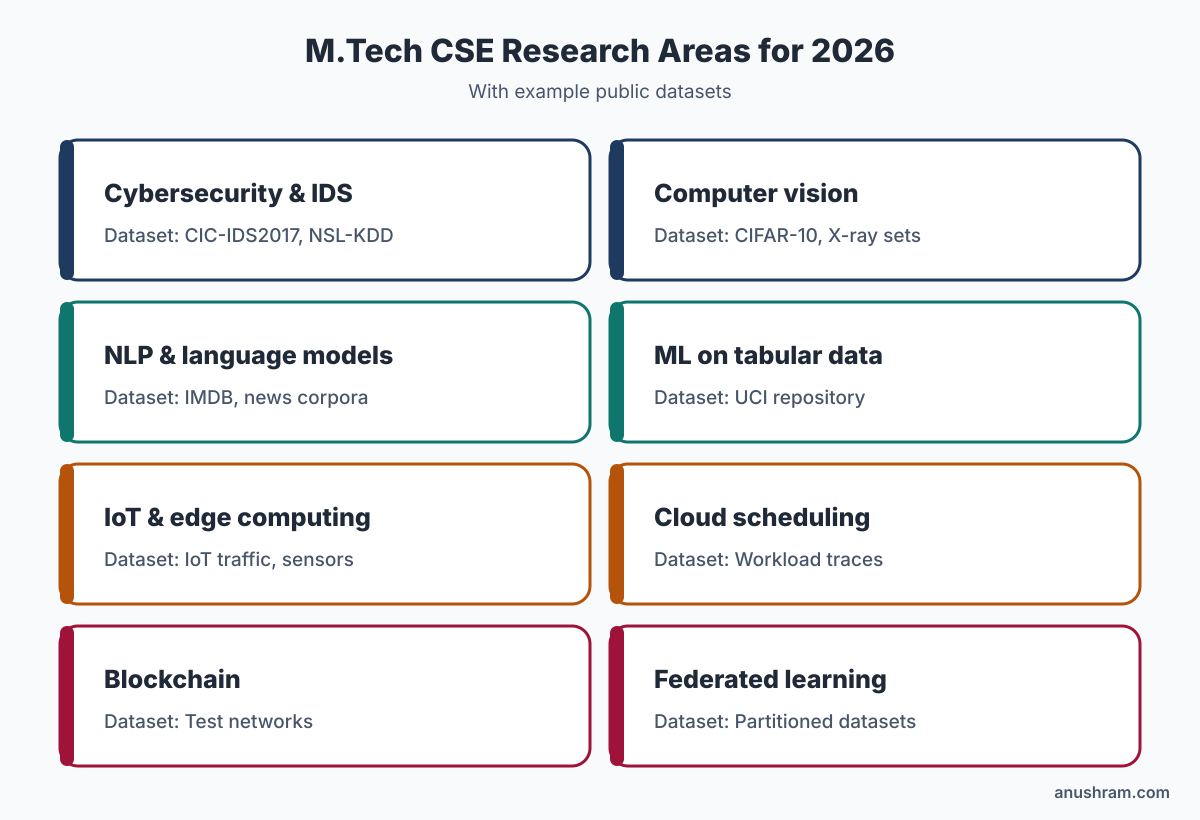
| Research area | Example public dataset | Typical tools |
| Intrusion detection and cybersecurity | CIC-IDS2017, NSL-KDD | Python, scikit-learn, TensorFlow |
| Computer vision and medical imaging | CIFAR-10, public chest X-ray sets | PyTorch, OpenCV |
| Natural language processing | IMDB reviews, public news corpora | Hugging Face Transformers, spaCy |
| Machine learning on tabular data | UCI Machine Learning Repository sets | scikit-learn, XGBoost |
| IoT and edge computing | Public sensor and IoT traffic sets | Python, iFogSim, Raspberry Pi |
| Cloud scheduling and resource allocation | Public cloud workload traces | CloudSim, Python |
| Blockchain applications | Simulated transactions or public chain data | Ethereum test networks, Solidity |
| Federated and privacy-preserving learning | Partitioned versions of standard sets | Flower, PyTorch |
Public datasets such as those in the UCI Machine Learning Repository[1] and the Canadian Institute for Cybersecurity's CIC-IDS2017[2] let examiners and reviewers check your work, which strengthens both your dissertation and any paper from it. Always read and follow each dataset's licence and citation instructions.
Looking for specific topics? Our upcoming list of M.Tech CSE thesis and dissertation topics for 2026 gives ready-to-refine ideas in each area.
The 8-step M.Tech CSE thesis and dissertation process
From topic to viva in eight steps.
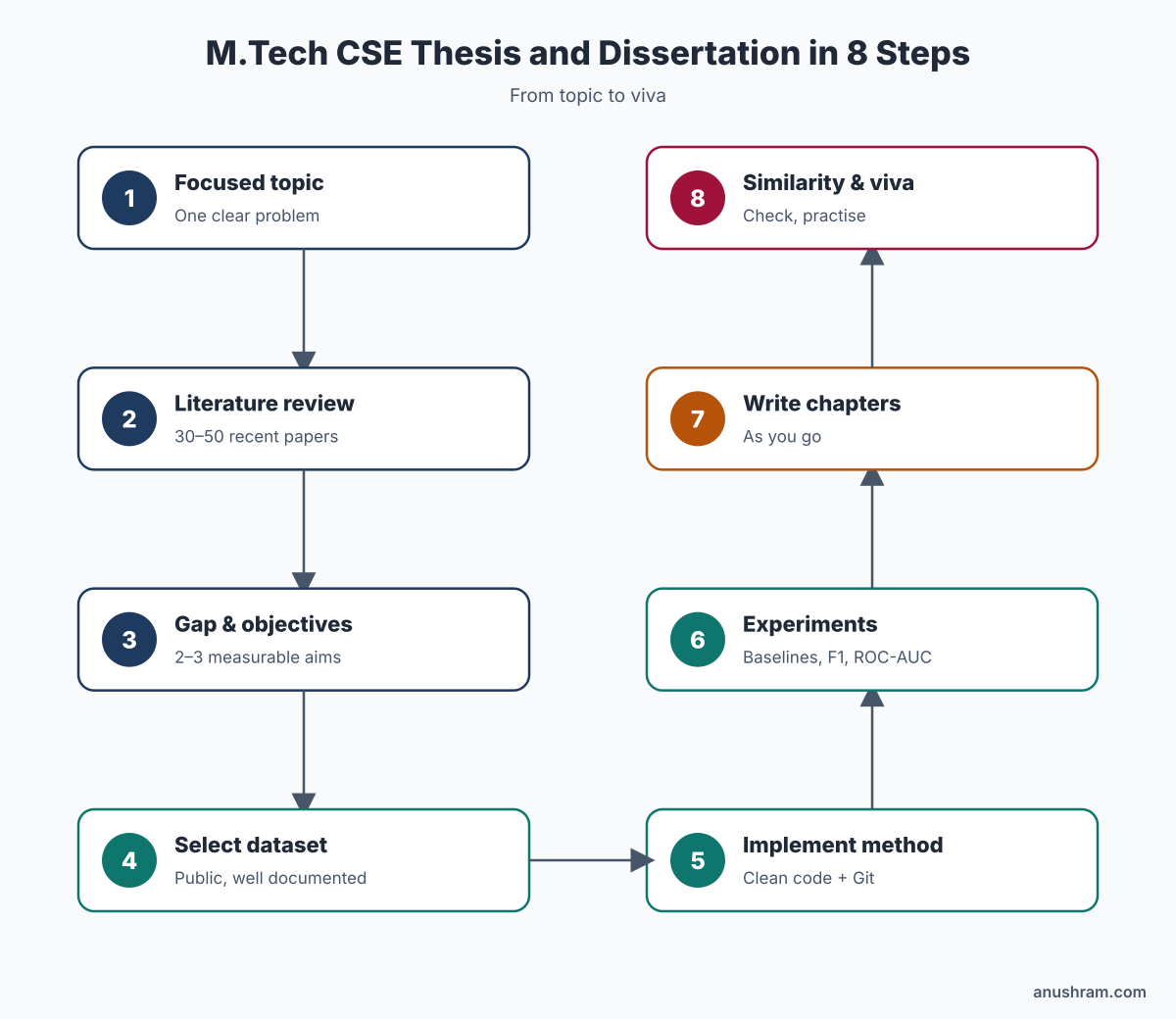
- Choose a focused topic. Pick an area you enjoy and narrow it to one problem, for example "lightweight intrusion detection for IoT networks" rather than "cybersecurity".
- Review the literature. Read 30 to 50 recent papers from IEEE Xplore, Scopus-indexed journals and good conferences. Record each paper's method, dataset and results in a table.
- Define the gap and objectives. State what existing work does not do well, and set two or three measurable objectives. Our guide on identifying a research gap shows how.
- Select the dataset. Prefer a public, widely used dataset so results can be compared. Describe preprocessing clearly.
- Implement your method. Write clean, commented code in Python or another suitable language. Use version control such as Git from the start.
- Run experiments and compare. Compare your method with at least two or three baselines on the same data split, using standard metrics.
- Write the chapters. Introduction, literature review, methodology, implementation, results and discussion, and conclusion with future work.
- Check similarity and prepare for the viva. Run the similarity check, fix any issues, and practise explaining every result.
What examiners expect from implementation and results
In CSE, the implementation and results chapters carry the most weight. Examiners look for:
- A clear experimental set-up: hardware, software versions, dataset split (for example 70/15/15 or k-fold cross-validation) and hyperparameters.
- Fair baselines: existing methods run on the same data, not numbers copied from papers with different settings.
- Suitable metrics: accuracy alone is not enough for imbalanced data. Report precision, recall, F1-score, ROC-AUC, or task-specific metrics such as BLEU or mean average precision.
- Statistical care: repeated runs with mean and standard deviation where results vary.
- Ablation or sensitivity analysis: showing which part of your method makes the difference.
- Reproducibility: code and instructions organised so the work can be re-run.
How long should each chapter be?
An illustrative page budget. Follow your university's format and length rules.
Give the most space to methodology, implementation and results, because that is where your contribution lives. Keep the literature review focused on work directly related to your gap.
Stuck on your M.Tech CSE topic, dataset or code? Book a free consultation with an Anushram CSE mentor and get a clear plan for your thesis and dissertation. Book your free consultation →
A sample weekly rhythm for the final semester
Students who finish on time usually keep a simple weekly routine: two or three focused coding and experiment sessions, one writing session for the current chapter, and a short weekly review with their guide or mentor. Keep a lab notebook or a simple log of every experiment, with the date, settings, dataset version and result. When you write the results chapter, this log becomes your most valuable document, and it lets you answer viva questions precisely.
Similarity and AI tools: rules to follow
Indian universities apply the UGC 2018 academic integrity regulations to master's dissertations as well as PhD theses. Similarity up to 10% is treated as minor with no penalty, while higher levels require revision and can lead to serious consequences.[3] Many universities set stricter limits, so check yours.
AI coding and writing assistants need care. The Committee on Publication Ethics states that AI tools cannot be authors and that authors must disclose how they used them.[4] In your dissertation:
- understand and be able to explain every line of code you submit
- never let an AI tool generate results, tables or references
- disclose AI assistance where your university requires it
- verify every reference yourself
Turn your dissertation into an IEEE or Scopus paper
A good M.Tech CSE dissertation often contains one publishable paper. A paper strengthens a PhD application, a job interview or an application to study abroad. Our guides on publishing an M.Tech paper in IEEE or Scopus and IEEE vs Scopus for M.Tech students explain how to choose a venue and verify indexing. A dedicated guide on an M.Tech CSE research paper with dataset and code is coming next in this series.
Why M.Tech students in India and abroad choose Anushram
What students value in Anushram's guidance.
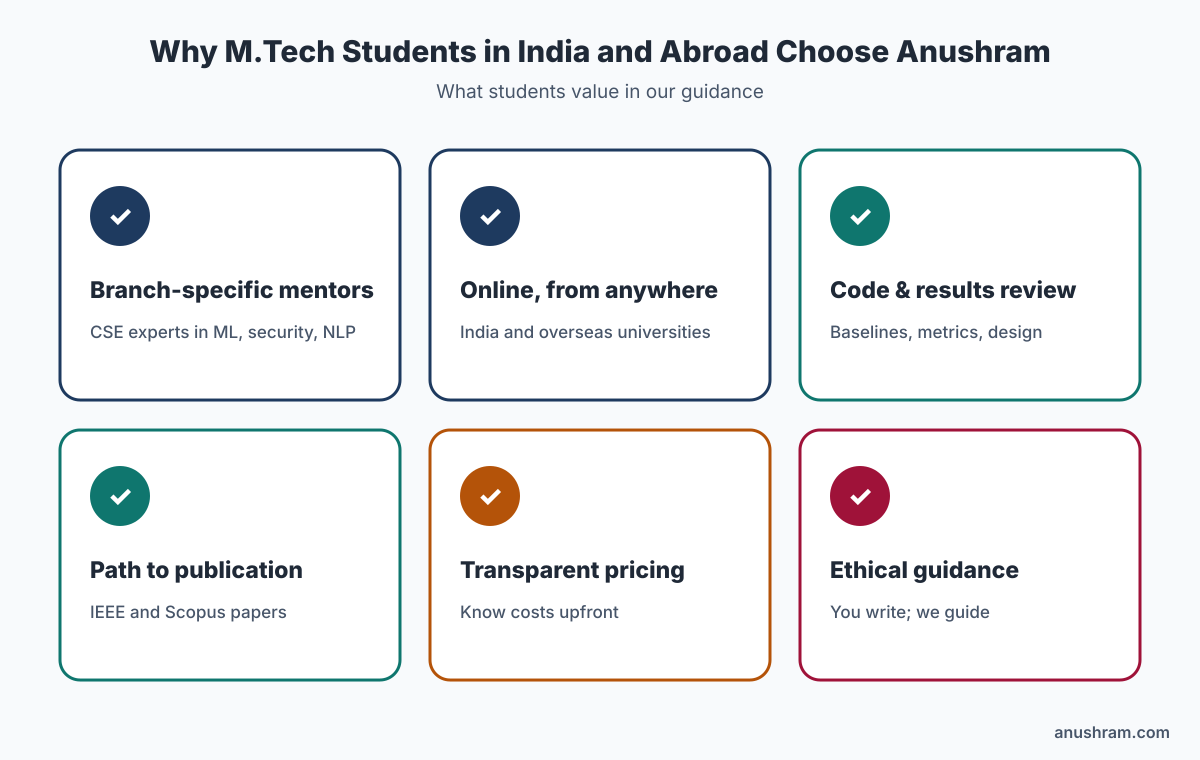
- Branch-specific mentors: CSE guidance from people who understand machine learning, security, NLP and systems research.
- Online, from anywhere: students at Indian and overseas universities work with us through video calls, shared documents and code reviews.
- Code and results review: feedback on your implementation, experiment design, baselines and metrics.
- A clear path to publication: help turning your dissertation into an IEEE or Scopus-indexed paper.
- Transparent pricing: see our pricing page before you commit.
- Ethical guidance: we guide, review and train; you write and implement. That keeps your degree safe and your viva confident.
Read more on our page about why M.Tech students in India and abroad choose Anushram.
Common mistakes M.Tech CSE students make
- A topic that is too broad, such as "AI in healthcare", with no specific problem.
- Copying baseline numbers from papers that used different data splits.
- Reporting only accuracy on imbalanced datasets.
- Untracked code, making results impossible to reproduce near submission.
- Leaving the writing to the last month. Write chapters as you go.
- Not understanding your own code, which shows quickly in the viva.
See our guide to common thesis mistakes for more.
How Anushram guides M.Tech CSE students
- Topic refinement and research gap analysis
- Dataset selection and experiment design
- Code review and implementation guidance
- Chapter-by-chapter feedback and formatting through our thesis assistance services
- Training in Python, machine learning tools and LaTeX
- Paper guidance through our research paper guidance
- Mock viva practice
Frequently asked questions
Q1. Can Anushram write my M.Tech CSE thesis or dissertation?
A. No. We guide, review, train and give feedback, but the research, code and writing must be your own. This protects your degree and prepares you for the viva.
Q2. Which dataset should I use for my M.Tech CSE dissertation?
A. Choose a public, widely used dataset that fits your problem, such as sets from the UCI Machine Learning Repository or CIC-IDS2017 for intrusion detection. Follow each dataset's licence.
Q3. Do overseas M.Tech or MS students work with Anushram?
A. Yes. Our guidance is online, so students can work with us from universities in India or abroad, following their own university's rules.
Q4. How long does an M.Tech CSE thesis and dissertation take?
A. Most programmes allow one or two semesters. With a clear plan, six months is realistic for topic, implementation, results and writing.
Q5. What similarity percentage is allowed?
A. Under the UGC 2018 regulations, up to 10% carries no penalty, but many universities set their own limits. Check your university's rules.
Q6. Can I publish my M.Tech CSE dissertation work?
A. Yes. Many students publish one paper in an IEEE conference or a Scopus-indexed journal. Check your university's rules on publishing dissertation work.
Conclusion
A successful M.Tech CSE thesis and dissertation is a well-run research project: a focused problem, a public dataset, a reproducible implementation, fair comparisons and honest writing. Follow the 8-step process, keep your code and results organised, respect the similarity and AI rules, and plan for a paper from the start. With the right guidance, you can finish on time and defend your work with confidence.
Start your M.Tech CSE thesis and dissertation with confidence
Get a free consultation with an Anushram CSE mentor:
- Topic and gap review for your area
- Dataset and experiment plan with baselines and metrics
- Code and results feedback as you work
- IEEE or Scopus paper path from your dissertation
We guide you; your thesis stays your own. Students from India and abroad welcome.
Or explore thesis guidance · See pricing · Call or WhatsApp: +91 96438 02216


