

Every mechanical engineering PhD scholar uses research databases every week: to find literature, check a journal, track citations and decide where to publish. Two names come up again and again: Scopus and IEEE Xplore. Both are valuable, but they are built for different jobs. Using the wrong one for a task wastes time and can leave gaps in your literature review.
This Anushram guide compares Scopus and IEEE Xplore from a mechanical PhD scholar's point of view. You will see what each one covers, how big each is, how to access them in India, which one to use for which task, a six-step literature search workflow that uses both, and how each helps when you publish. The aim is simple: a faster, more complete literature review and better publishing decisions throughout your PhD.
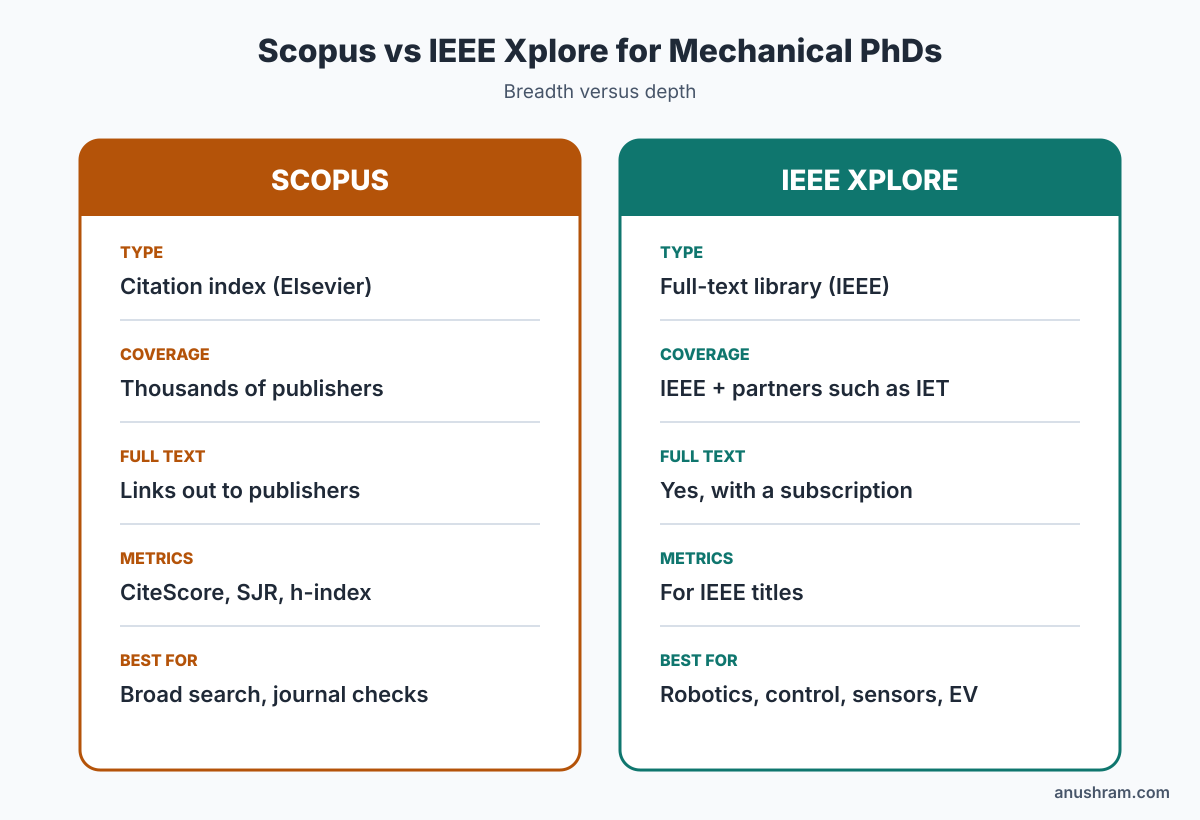
In short: Scopus is a broad citation index across almost all publishers. Use it to search the literature widely, check journals and metrics, and track citations. IEEE Xplore is IEEE's full-text library. Use it for deep reading in mechatronics, robotics, control, sensors and electric vehicles. Most mechanical PhD scholars need both: Scopus for breadth and IEEE Xplore for depth in interdisciplinary topics.
Scopus vs IEEE Xplore at a glance
Breadth versus depth: two tools for two jobs.
| Feature | Scopus | IEEE Xplore |
| Type | Abstract and citation database | Full-text digital library |
| Owner | Elsevier | IEEE |
| Publishers covered | Thousands, including Elsevier, Springer, ASME, Taylor & Francis and IEEE | Mainly IEEE, plus partners such as IET |
| Full text | Links out to publishers | Full text of IEEE content with a subscription |
| Journal metrics | CiteScore, SJR and SNIP, free on Scopus Sources | Shows metrics for IEEE titles |
| Author metrics | Author profiles with h-index | Author pages for IEEE publications |
| Best for mechanical PhDs | Broad literature search, journal selection, citation tracking | Mechatronics, robotics, control, sensors, EV research |
How big is each database?
IEEE Xplore crossed seven million documents in total.[1] According to IEEE's 2026 library brochure, it includes more than 1.4 million articles from 214 IEEE journals, magazines and transactions, and more than 4.8 million conference papers.[2] Scopus passed 100 million content items in February 2025, including 12.9 million conference papers from about 167,000 conference events.[3]
For a mechanical PhD scholar, this means Scopus will find most of the thermal, manufacturing, materials and design literature you need, while IEEE Xplore gives full-text depth in the electrical and computing side of interdisciplinary work. If you are an M.Tech student, our simpler guide on IEEE vs Scopus for M.Tech mechanical students may suit you better.
Access in India: One Nation One Subscription
Since January 2025, India's One Nation One Subscription (ONOS) scheme has provided access to scholarly journals from about 30 publishers for government-funded institutions. The national portal lists more than 13,000 journal titles.[4] IEEE is one of the participating publishers, and its publications are delivered through IEEE Xplore.[5]
Journals available through ONOS from selected publishers, as listed by an institutional library.
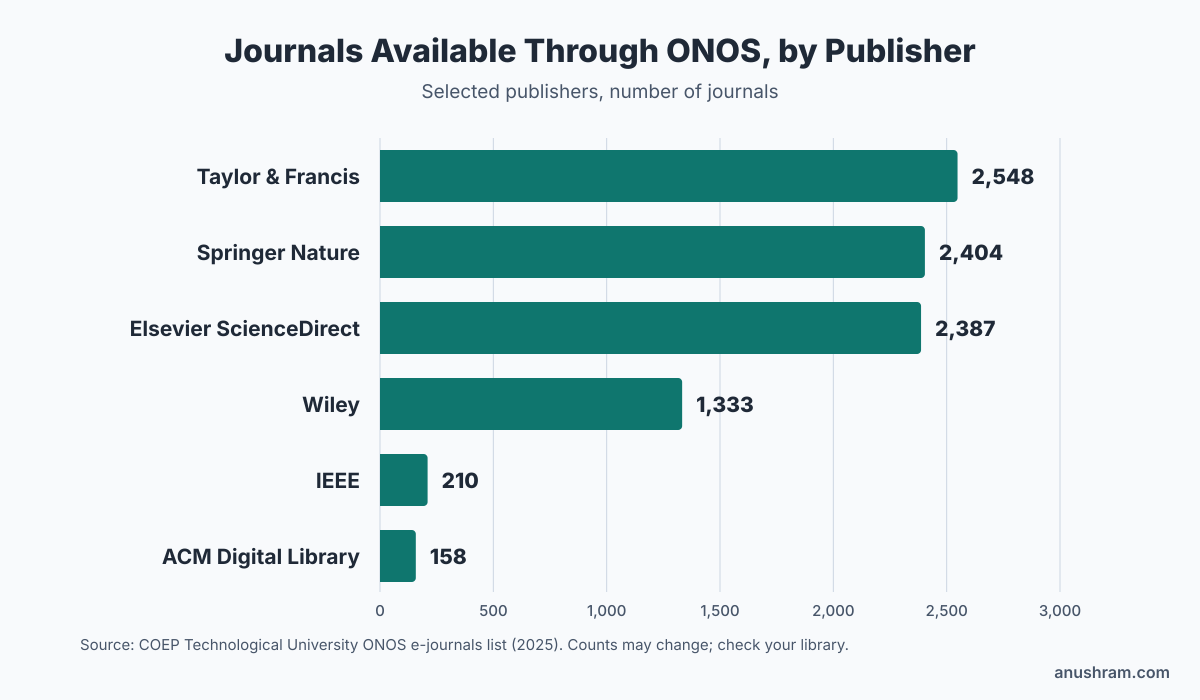
One institutional ONOS list shows 2,548 Taylor & Francis journals, 2,404 Springer Nature journals, 2,387 Elsevier ScienceDirect journals, 1,333 Wiley journals and 210 IEEE journals.[6] IEEE has fewer journals, but they are highly focused on engineering and computing.
ONOS gives you access to journal articles. Access to the Scopus database itself depends on your institution's own subscription, so ask your library. Anyone can use the free Scopus Sources page to check journal coverage and metrics.[7]
Which tool for which task?
Pick the tool by task, not by habit.
| Task | Best tool | Why |
| Broad literature search on a mechanical topic | Scopus | Covers most mechanical publishers in one search |
| Deep reading on robotics, control or sensors | IEEE Xplore | Full text of IEEE journals and conferences |
| Checking whether a journal is indexed | Scopus Sources | Free, official source of coverage status |
| Comparing journal metrics | Scopus Sources | CiteScore, SJR and quartiles by category |
| Finding who cites a key paper | Scopus | Citation links across publishers |
| Finding IEEE standards | IEEE Xplore | Hosts IEEE standards documents |
| Tracking your own citations and h-index | Scopus | Author profiles with h-index |
| Identifying a research gap | Both | Scopus for breadth, IEEE Xplore for interdisciplinary depth |
Struggling with a literature review that never ends? Get a structured search strategy and gap analysis plan from an Anushram mechanical engineering mentor. Book a free review →
A six-step literature search workflow using both
Breadth first, then depth, then alerts.
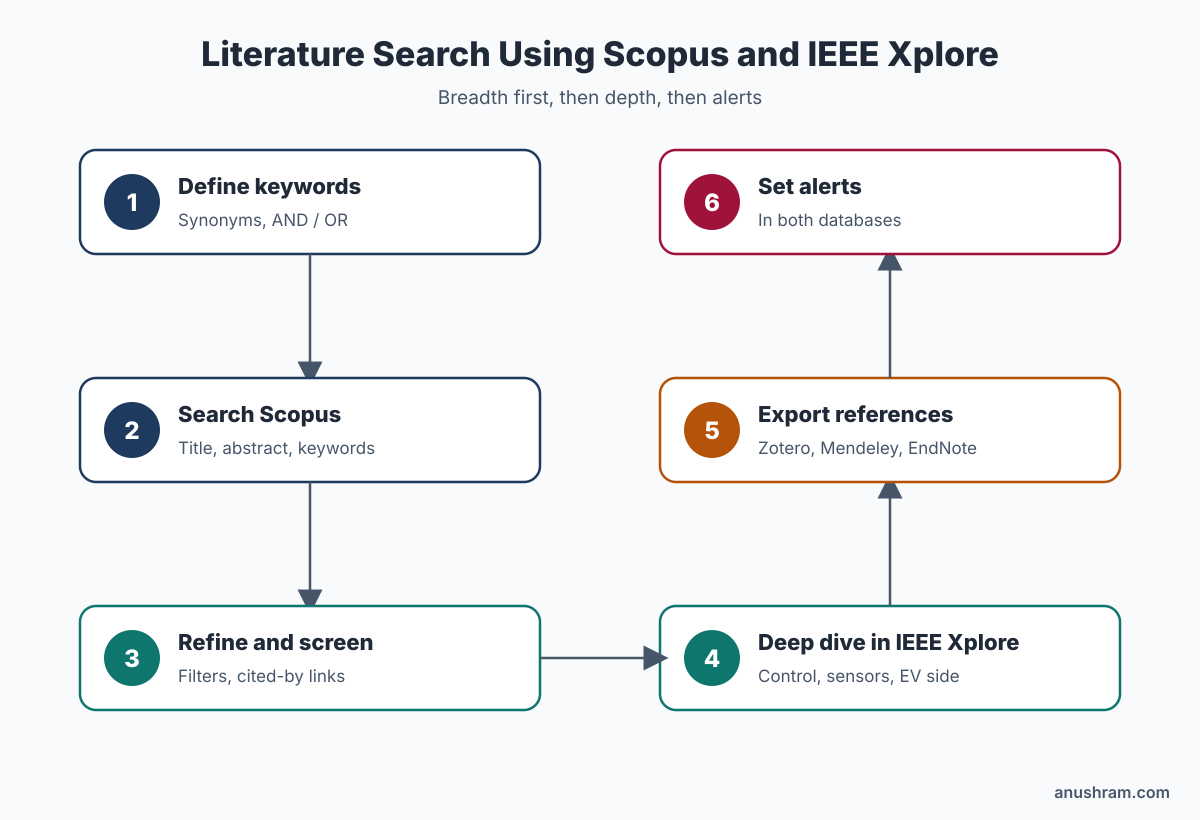
- Define keywords and synonyms. For example "battery thermal management" OR "BTMS", combined with "phase change material" OR "PCM" and "liquid cooling".
- Search Scopus in title, abstract and keywords. Combine terms with AND, OR and quotation marks.
- Refine and screen. Filter by year, subject area and document type, then screen titles and abstracts. Use the citation counts and "cited by" links to find key papers.
- Deep dive in IEEE Xplore for the electrical, control or sensor side of your topic, and for relevant IEEE conference papers.
- Export to a reference manager such as Zotero, Mendeley or EndNote, and remove duplicates.
- Set alerts in both databases so new papers come to you as your PhD progresses.
This workflow feeds directly into gap analysis. Our guide on how to identify a research gap shows the next step.
Example search strings for mechanical topics
Good search strings save hours. Here are illustrative examples you can adapt in Scopus (use the "Article title, Abstract, Keywords" field) and in IEEE Xplore's advanced search:
| Topic | Example search string |
| Battery cooling | ("battery thermal management" OR BTMS) AND ("phase change material" OR "liquid cooling") |
| Machining | ("surface roughness" OR "tool wear") AND (Inconel OR "titanium alloy") AND (MQL OR cryogenic) |
| Fault diagnosis | ("bearing fault" OR "gear fault") AND (vibration) AND ("deep learning" OR CNN) |
| Composites | ("natural fibre" OR "natural fiber") AND composite AND ("tensile strength" OR "impact strength") |
| Heat exchangers | (nanofluid) AND ("heat exchanger") AND ("heat transfer coefficient" OR "pressure drop") |
Include both British and American spellings, run the same string in both databases, and record the date and number of results. This makes your literature review reproducible, which examiners and reviewers appreciate.
Using Scopus and IEEE Xplore when you publish
Scopus for journal decisions
- Check that a journal is active and indexed before you submit.
- Compare CiteScore, SJR and quartiles within your subject category. CiteScore is based on citations over a four-year window.[7]
- Look at where the key papers in your field were published. Those journals are natural targets.
IEEE Xplore for interdisciplinary venues
- Find IEEE journals and conferences that publish work like yours in mechatronics, robotics, sensors and EVs.
- Check past conference proceedings to judge the quality and scope of an event.
- Use the IEEE author tools and templates when preparing a manuscript for an IEEE venue.
For the full publishing process, read our guide on mechanical PhD papers in Scopus and IEEE and our explainer on Scopus vs SCI journals.
Your author profile and h-index
Scopus automatically creates author profiles and shows the h-index, the largest number h of your papers that have each been cited at least h times.[7] As a PhD scholar:
- check your Scopus author profile after your first paper is indexed
- request corrections if papers are missing or merged with another author
- link your profile to your ORCID iD so your work is correctly attributed
- remember that the h-index favours senior researchers; for a PhD scholar, the quality and fit of each paper matter more
Common mistakes PhD scholars make
- Searching only one database. A Scopus-only search can miss IEEE conference depth; an IEEE-only search misses most mechanical journals.
- Relying on Google Scholar alone. It is useful, but it mixes peer-reviewed and non-reviewed sources and does not confirm indexing.
- Trusting a journal website's indexing claim. Always confirm on the Scopus Sources page.
- Comparing metrics across fields. Compare quartiles within your subject category instead.
- Not saving searches. Record your search strings and dates; examiners may ask how you searched.
These issues often show up as thesis weaknesses. See our guide to common PhD thesis mistakes.
How Anushram helps mechanical PhD scholars
- Literature search strategies using Scopus and IEEE Xplore
- Research gap analysis and review chapter feedback
- Journal shortlisting with indexing and metrics verified
- Paper guidance through our research paper guidance
- Research training, including reference managers, LaTeX, ANSYS and MATLAB
- Thesis support through our PhD thesis assistance
https://www.anushram.com/writing-services/thesis-assistance-phd
We guide you; your research stays your own. See our pricing or read our mechanical engineering PhD thesis guidance.
Frequently asked questions
Q1. Is Scopus better than IEEE Xplore for mechanical PhD research?
For broad mechanical literature, Scopus covers more publishers. For mechatronics, robotics, control and sensors, IEEE Xplore gives deeper full-text access. Most scholars use both.
Q2. Is IEEE Xplore included in Scopus?
Many IEEE journals and conference proceedings are indexed in Scopus, but Scopus decides coverage title by title. Check each title on the Scopus Sources page.
Q3. Can I access IEEE Xplore through ONOS?
IEEE is one of the ONOS publishers, delivered through IEEE Xplore. Access depends on your institution being part of ONOS, so check with your library.
Q4. Is Scopus free to use?
The full Scopus database needs an institutional subscription, but the Scopus Sources page with journal metrics is free.
Q5. How do I find my h-index?
Search for your name in Scopus author search, open your profile and view the h-index. Link it to your ORCID iD to keep it accurate.
Q6. Should I also use Web of Science?
If your institution subscribes, yes. Web of Science is used for SCI and SCIE indexing and the Journal Impact Factor. See our Scopus vs SCI guide.
Conclusion
Scopus and IEEE Xplore are partners, not rivals. Scopus gives a mechanical PhD scholar breadth: a wide literature search, journal checks, metrics and citation tracking. IEEE Xplore gives depth in the electrical, control and computing side of modern mechanical research. Use both in a structured workflow, confirm indexing on the Scopus Sources page, and your literature review and publication choices will be stronger for it.
Research smarter with Anushram
Get a free research review from an Anushram mechanical engineering mentor:
- Search strategy for Scopus and IEEE Xplore
- Gap analysis for your literature review
- Journal shortlist with indexing verified
- Paper and thesis guidance from draft to defence
We guide you; your research stays your own.
Book your free research review →
Or explore PhD thesis guidance · See pricing · Call or WhatsApp: +91 96438 02216

