

Starting a PhD is exciting, but the first six months decide a lot. Scholars who understand the rules, plan their topic carefully and set up good habits early usually finish on time. Those who learn the rules by mistake often lose a year or more.
This guide covers 15 things every PhD scholar must know before starting research, based on the UGC PhD Regulations 2022, the UGC plagiarism regulations of 2018 and our experience mentoring research scholars across India.
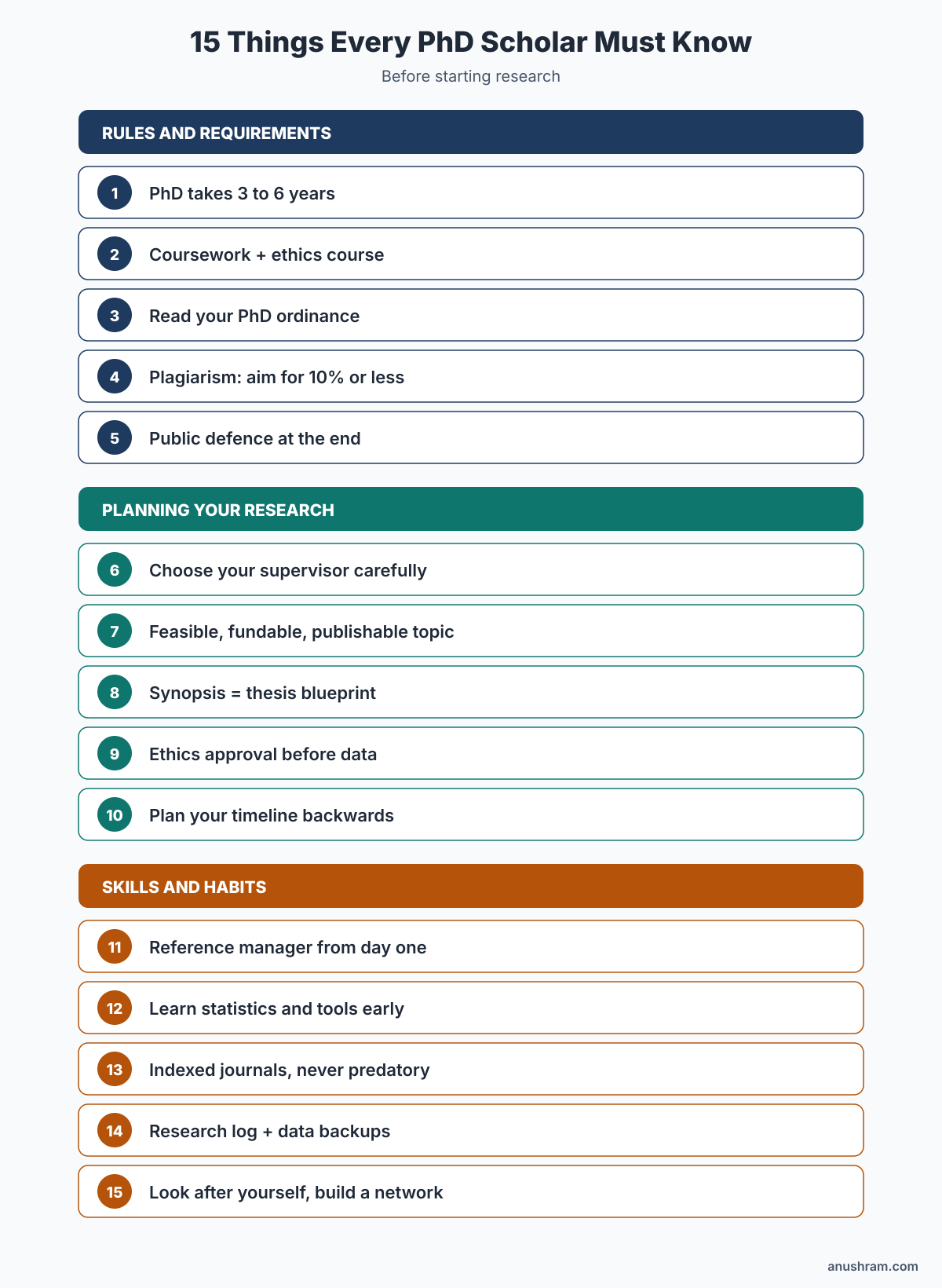
Part 1: Rules and requirements
1. A PhD takes 3 to 6 years
Under the UGC PhD Regulations 2022, a PhD lasts at least three years, including coursework, and must be completed within six years of admission. Female scholars and persons with disabilities get up to two extra years.[1] Plan for four years, not three. Ethics approvals, data collection and journal reviews almost always take longer than expected.
2. Coursework comes first, including a compulsory ethics course
Every new PhD scholar must complete pre-PhD coursework. It includes a two-credit, 30-hour course on Research and Publication Ethics.[2] Treat it as practical training, not a formality. It covers plagiarism, authorship disputes, data fabrication and predatory journals, the same issues that can derail a thesis later.
3. Read your university's PhD ordinance
UGC sets the minimum rules, but each university adds its own: progress report dates, publication requirements, thesis format, fees and submission steps. Download your university's PhD ordinance on day one and keep it handy. Many delays come from missing a requirement that was written there all along.
4. Plagiarism has clear levels and penalties
UGC's 2018 plagiarism regulations set four levels for theses: similarity up to 10% carries no penalty; above 10% to 40% means revising the thesis within six months; above 40% to 60% bars resubmission for a year; and above 60% leads to cancellation of registration.[3] Quoted and properly cited material, references and acknowledgements are excluded from the check.[4] Aim for 10% or less from your very first draft.
5. Your PhD ends with a public defence
Once the external examiners approve the thesis, you must defend it in a public viva voce, open to faculty, scholars and other interested people.[5] Knowing this from the start changes how you work: keep records that let you explain every decision you made.
Part 2: Planning your research
6. Choose your supervisor as carefully as your topic
Your supervisor shapes your next four years. Before you commit, ask:
- How many scholars has this supervisor guided to completion, and how long did they take?
- Does the lab or department have the equipment your topic needs?
- How often will you meet, and how quickly does the supervisor give feedback?
Talk to current and former scholars. Their answers are more honest than any prospectus.
7. Pick a topic that is feasible, fundable and publishable
A good topic is interesting, but it must also be possible with your resources and time. Test it against the FINER checklist (feasible, interesting, novel, ethical, relevant) and add two PhD-specific checks: can it be funded, and can it be published in indexed journals? Our guide to PhD research topics and the 7-point topic test shows how to score a topic before you commit.
8. Your synopsis is the blueprint of your thesis
Do not treat the synopsis as a permission form. Write three to five clear objectives, and plan for each one to become a thesis chapter and a journal paper. Examiners will compare your final thesis with the approved synopsis. Our synopsis to defence roadmap explains how to map objectives to chapters and papers.
9. Get ethics approval before you collect any data
If your research involves people, patient records, animals or sensitive data, you need approval from the relevant ethics committee before you start. Data collected without approval may not be usable in your thesis or publishable in a journal.
10. Plan your timeline backwards
Start from your target submission date and work back: pre-submission seminar, publications, data analysis, data collection, approvals. A backward plan shows you early whether your timeline is realistic.
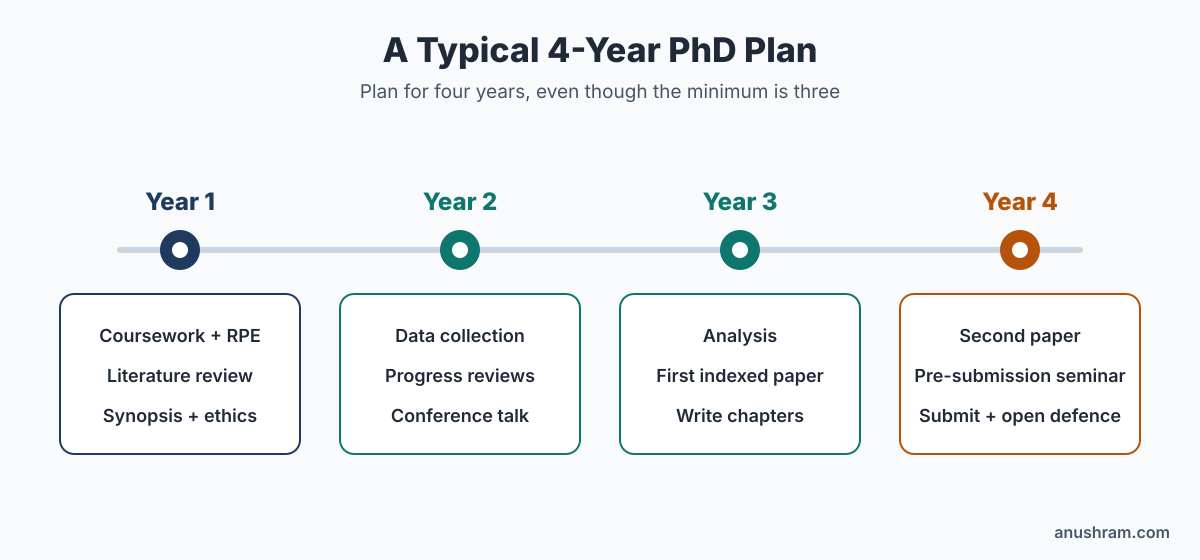
A typical four-year PhD plan.
Not sure your topic or supervisor choice is right? A 20-minute talk with a research mentor can save you months. Book a free consultation →
Part 3: Skills and habits
11. Use a reference manager from day one
Free tools such as Zotero or Mendeley store your papers, notes and citations, and format your reference list automatically. Starting on day one saves weeks of work when you write your literature review and thesis.
12. Learn statistics and research tools early
Do not leave analysis to the end. Learn the basics of the tools your field uses, such as SPSS, R, Python, MATLAB or LaTeX on Overleaf for technical writing. Plan your sample size and analysis before collecting data, not after. Our research training programmes cover these skills step by step.
13. Publish in indexed journals, and avoid predatory ones
Most universities expect indexed journal papers before thesis submission. Choose journals listed in Scopus or Web of Science, check that the listing is current, and be wary of journals that promise fast acceptance for a fee. Our guide to Scopus-indexed Q1 and Q2 journal publication explains how to check a journal.
14. Keep a research log and back up your data
Write down what you did each day, what worked and what did not. Keep your raw data in at least two places, such as a cloud drive and an external disk. A lost laptop should never mean a lost PhD.
15. Look after yourself and build a network
A PhD is a marathon. Regular sleep, exercise and time away from work keep you productive. Join seminars, conferences and online research groups. Your fellow scholars will become your collaborators, reviewers and support system.
Quick summary
| Area | What to remember |
| Duration | 3 to 6 years (plus 2 for women and persons with disabilities) |
| Coursework | Includes a 2-credit Research and Publication Ethics course |
| Plagiarism | 10% or less carries no penalty |
| Topic | Feasible, fundable and publishable |
| Synopsis | Each objective becomes a chapter and a paper |
| Publications | Indexed journals only |
| Final step | Public viva voce (open defence) |
Frequently asked questions
Q1. What is the minimum duration of a PhD in India?
Under the UGC PhD Regulations 2022, the minimum duration is three years including coursework, and the maximum is six years. Women and persons with disabilities get up to two extra years.
Q2. What is the allowed plagiarism in a PhD thesis?
Under the UGC 2018 regulations, similarity up to 10% carries no penalty. Some universities set stricter limits, so check your ordinance.
Q3. Is the Research and Publication Ethics course compulsory?
Yes. UGC made a two-credit, 30-hour Research and Publication Ethics course compulsory as part of pre-PhD coursework.
Q4. What should I do in the first month of my PhD?
Read your university's PhD ordinance, meet your supervisor to agree on expectations, set up a reference manager, start a research log and begin a focused literature search.
Conclusion
A PhD is not won in the final year. It is won in the first few months, when you learn the rules, choose the right supervisor and topic, and build habits that carry you through. Know your timeline of three to six years, take the ethics course seriously, keep similarity at 10% or less, and write a synopsis that already maps out your chapters and papers. Then publish in indexed journals, protect your data and look after yourself.
None of these 15 points is difficult on its own. The challenge is remembering all of them while you juggle coursework, experiments and deadlines. Save the checklist in this article, share it with your batchmates, and revisit it at the start of each semester. Scholars who plan early do not just finish on time. They finish with stronger papers, a confident defence and a clear next step in their career.
Ready to start your PhD the right way?
Anushram's research mentors help scholars across India at every stage:
- Topic selection and literature gap analysis
- Synopsis structuring, with objectives mapped to chapters and papers
- Statistics guidance you can explain and defend in your viva
- Publication support for choosing the right indexed journals
We guide you; your research stays your own.
Or explore PhD thesis guidance · See pricing · Call or WhatsApp: +91 96438 02216


