

Every PhD thesis must answer one question before any other: what does your research add that is not already known? That missing piece is your research gap. Examiners look for it in your synopsis, reviewers look for it in your papers, and your viva panel will ask you to defend it.
Yet many scholars struggle to find one. They read hundreds of papers and still feel that "everything has been done". This guide shows you a clear, step-by-step method to identify a genuine research gap, turn it into a research problem and research questions, and check that it is strong enough for a PhD thesis.
What is a research gap?
A research gap is a question, population, method or problem that existing studies have not addressed, have addressed poorly, or have answered in conflicting ways. It is not simply a topic nobody has studied. A topic may be unstudied because it does not matter.
Three related terms are often confused:
| Term | What it means | Example |
| Research gap | What is missing in current knowledge | No study has tested this method on Indian patients |
| Research problem | Why that missing knowledge matters | Doctors apply results from other populations without local evidence |
| Research question | What your study will answer | How accurate is this method in Indian patients? |
A strong PhD thesis connects all three: the gap leads to the problem, and the problem leads to your research questions.
The 7 types of research gaps
A widely cited taxonomy by D. Anthony Miles (2017) groups research gaps into seven types: evidence, knowledge, practical-knowledge conflict, methodological, empirical, theoretical and population gaps.[1] Knowing these types helps you look for gaps deliberately instead of waiting for one to appear.
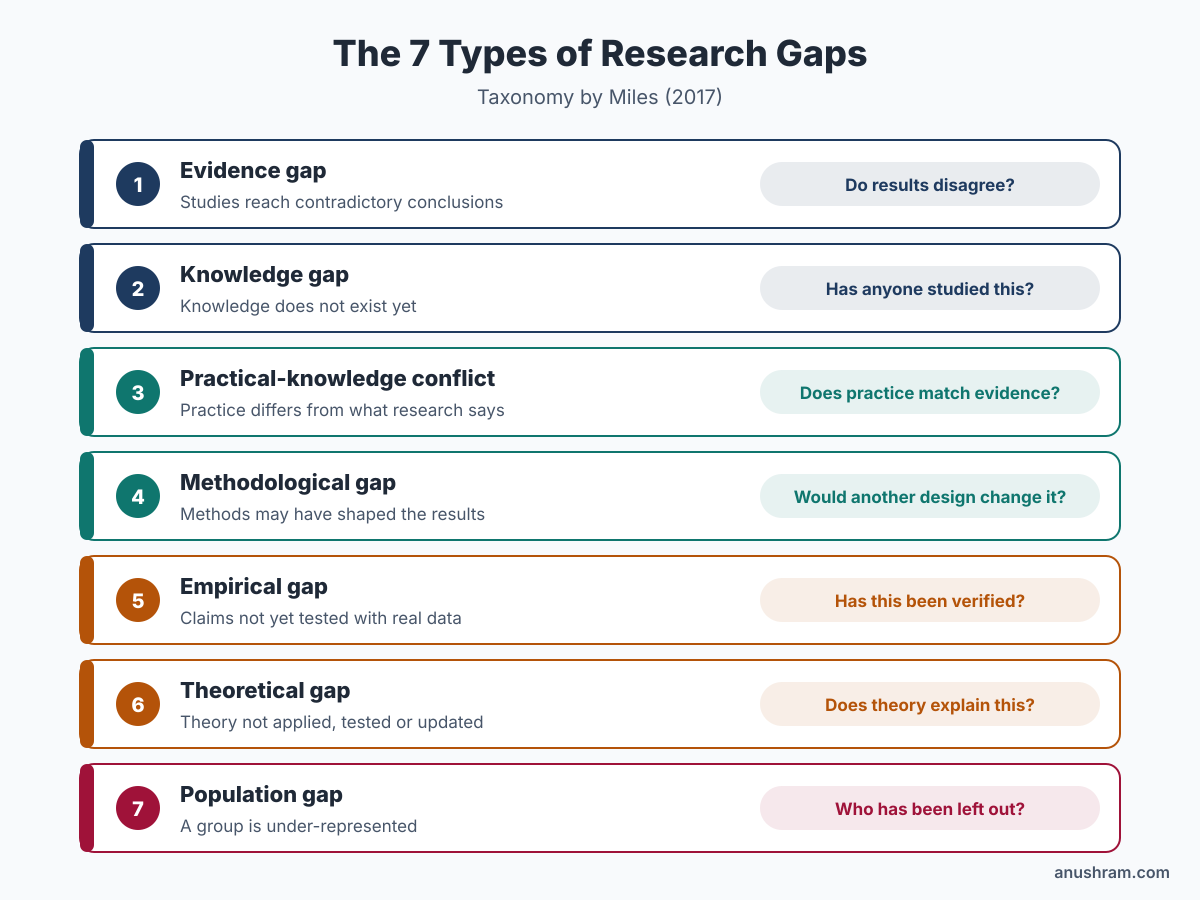
The seven types of research gaps, with a question to ask for each.
| Type of gap | What it means | Ask yourself |
| Evidence gap | Studies reach contradictory conclusions[2] | Do results disagree? Why? |
| Knowledge gap | Knowledge on the topic does not exist, or the expected results were not found | Has anyone studied this at all? |
| Practical-knowledge conflict | What practitioners do differs from what research says | Does practice match the evidence? |
| Methodological gap | The methods used may have shaped the results | Would a different design change the answer? |
| Empirical gap | Findings or claims have not been tested with real data | Has this been verified empirically? |
| Theoretical gap | Theory has not been applied, tested or updated | Does current theory explain this? |
| Population gap | A group is under-represented or under-researched[2] | Who has been left out? |
How to identify a research gap: 8 steps
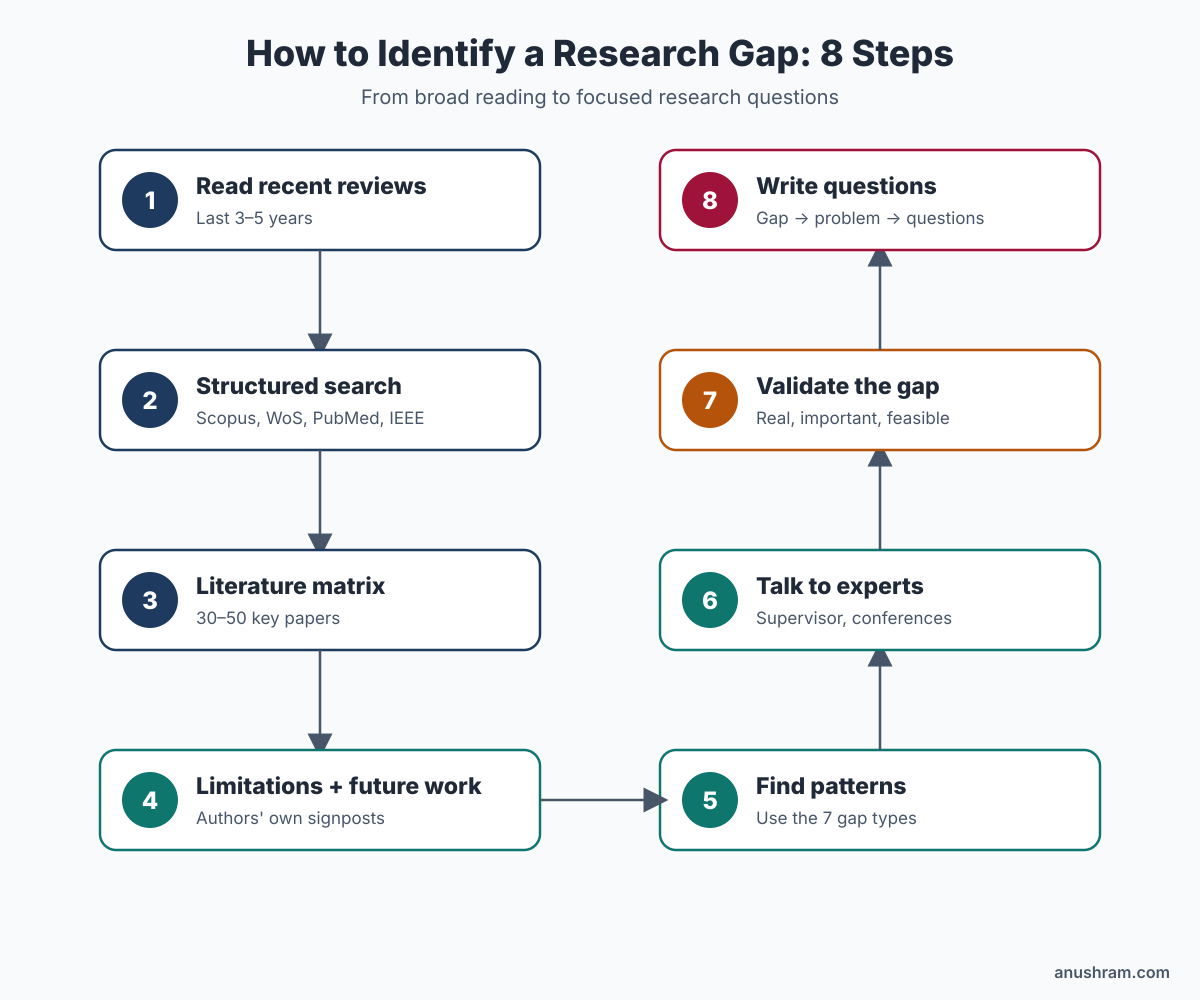
The 8-step research gap identification process.
Step 1: Start broad with recent review articles
Begin with systematic reviews, meta-analyses and narrative reviews published in the last three to five years. They summarise what is known and often say directly what is not. A good review saves you weeks of reading and gives you the key papers to follow.
Step 2: Run a structured literature search
Search Scopus, Web of Science, PubMed, IEEE Xplore or the databases of your field, not just Google Scholar. Write down your keywords, synonyms and Boolean combinations (AND, OR, NOT), and record how many results each search returns. If you plan a systematic review, follow the PRISMA 2020 guideline, which includes a 27-item checklist and flow diagrams for reporting how studies were identified and selected.[3]
Step 3: Build a literature matrix
A literature matrix is a simple table that turns reading into analysis. For each paper, record:
- Author and year
- Country and population
- Study design and sample size
- Main findings
- Limitations stated by the authors
- Future research they suggest
After 30 to 50 papers, patterns become visible: the same population studied again and again, the same method used by everyone, or results that do not agree.
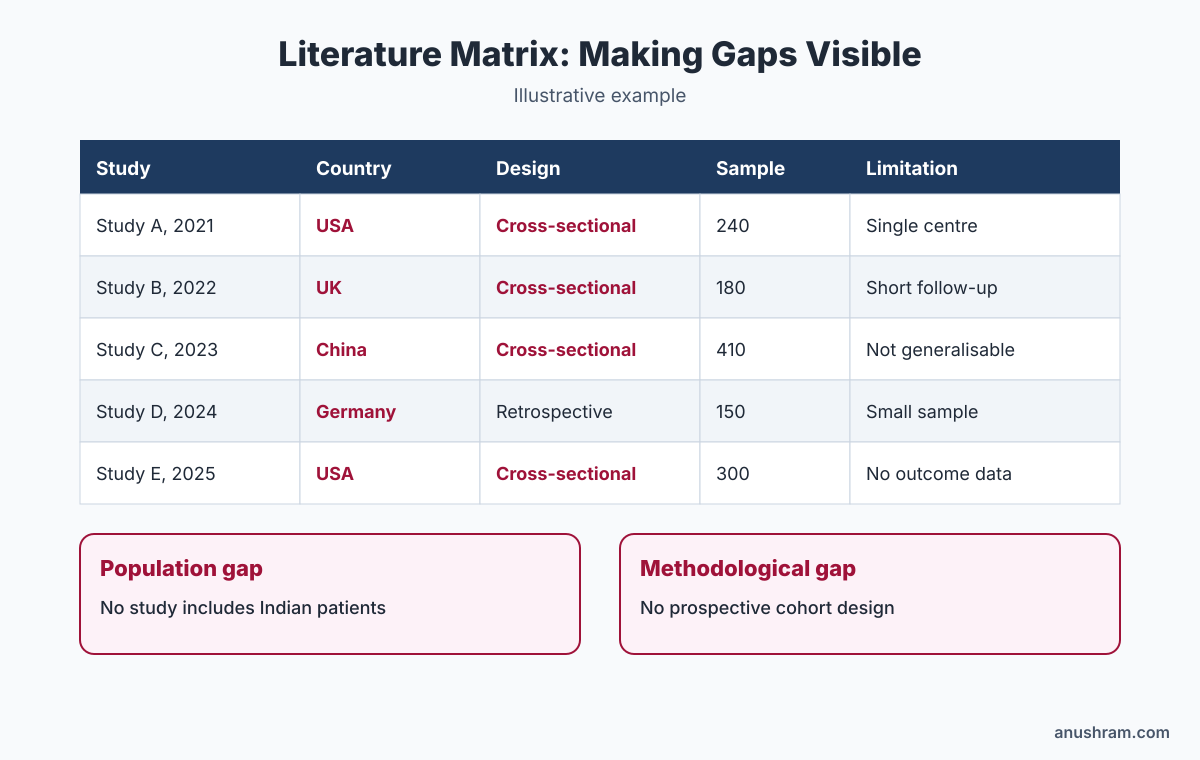
A literature matrix makes gaps visible: here, no study covers Indian patients or uses a cohort design.
Step 4: Read the limitations and future research sections
Authors often tell you exactly where the gaps are. Phrases such as "further studies are needed", "limited by small sample size" or "not generalisable to other populations" are signposts. If several authors mention the same limitation, you may have found a strong gap.
Step 5: Look for patterns across studies
Use the seven gap types as a lens. Are results contradictory (evidence gap)? Is everyone using a cross-sectional design (methodological gap)? Are women, older adults, rural communities or Indian populations missing (population gap)? Is an old theory still being used to explain new technology (theoretical gap)?
Step 6: Talk to experts and practitioners
Discuss your observations with your supervisor, senior researchers and people who work in the field. Conferences, webinars and department seminars are valuable: practitioners often know problems that have not yet reached the literature.
Found a possible gap but not sure it is strong enough? Our research mentors can review your literature matrix and help you test it. Book a free consultation →
Step 7: Validate the gap
Before you commit three or more years to a gap, test it with five questions:
- Is it real? Search again with different keywords. Make sure a recent paper has not already filled it.
- Does it matter? Will filling it change practice, policy, theory or technology?
- Is it feasible? Do you have the data, equipment, participants and time?
- Is it big enough for a PhD? Can it support three to five objectives and at least two papers?
- Is it small enough to finish? Can you complete it within your PhD timeline?
Our guide to choosing PhD research topics with the 7-point topic test explains how to score feasibility, funding and publishability.
Step 8: Turn the gap into a research problem and questions
Write a short gap statement using this template:
"Previous studies have examined [topic] in [population / context / method]. However, little is known about [the gap]. This matters because [consequence]. Therefore, this study aims to [aim]."
Then convert the aim into three to five specific research questions. Each question should become a thesis objective, a chapter and, ideally, a journal paper. Our synopsis to defence roadmap shows how to map objectives to chapters and papers.
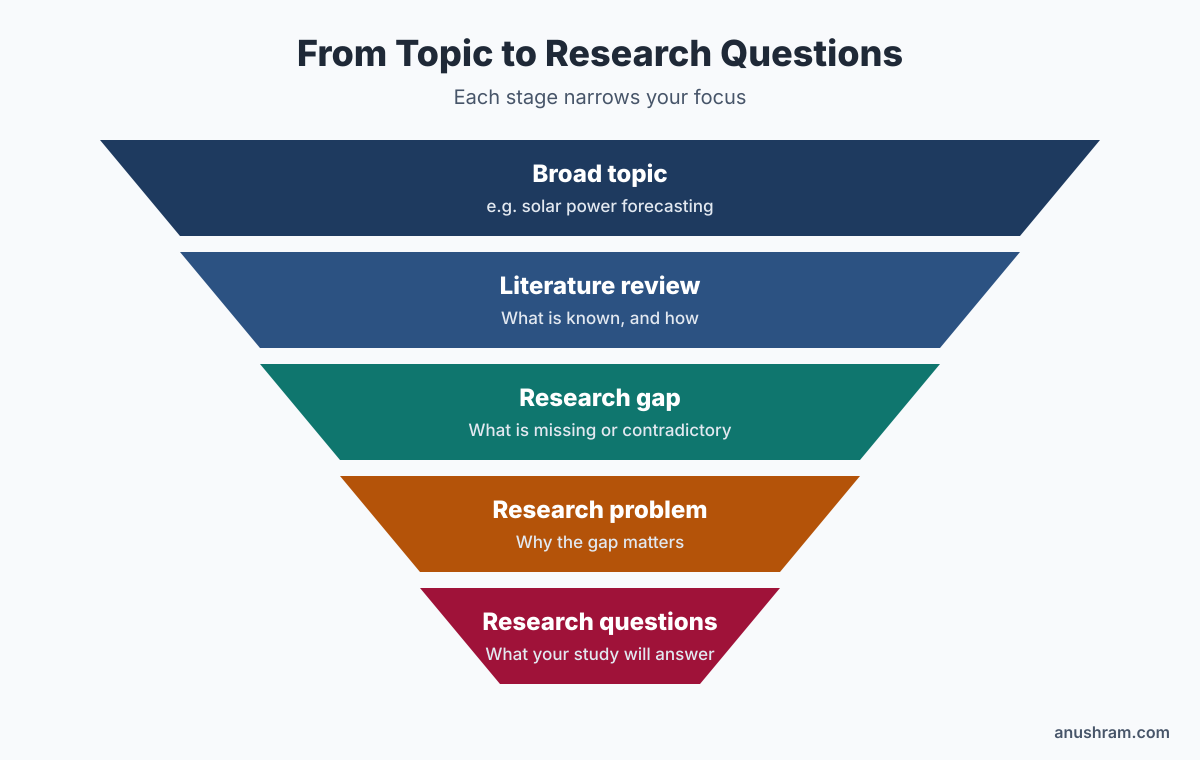
From a broad topic to focused research questions.
Two quick examples
Engineering: Many studies test a machine learning model for solar power forecasting using data from Europe and the USA. Few use data from Indian climatic zones with monsoon variability. Gap type: population (context) gap. Research question: How accurately does the model forecast solar output across Indian climatic zones?
Health sciences: Most studies on a biomarker are cross-sectional, so it is unclear whether it predicts outcome. Gap type: methodological gap. Research question: Does the biomarker predict disease progression over three years in a prospective cohort?
Common mistakes to avoid
- Claiming "no study has been done" without proof. Examiners will search. Show the evidence of your search.
- Choosing a gap that is too broad. "Improving education in India" is not a gap; it is a field.
- Relying only on AI tools. AI summaries can miss papers or invent references. Always verify in databases.
- Ignoring the latest papers. A gap from a 2015 review may already be filled. Check the last two years.
- Confusing a gap with a personal interest. Your interest matters, but the gap must also matter to the field.
New to research? Read our guide to the 15 things every PhD scholar must know before research.
Frequently asked questions
Q1. What is a research gap in a PhD thesis?
A research gap is a question, population, method or problem that existing studies have not addressed, have addressed poorly, or have answered in conflicting ways. Your PhD thesis should fill it with original research.
Q2. How do I find a research gap quickly?
Start with recent review articles, build a literature matrix of 30 to 50 key papers, and read their limitations and future research sections. Look for repeated limitations, contradictory results and missing populations or methods.
Q3. What are the types of research gaps?
A widely used taxonomy by Miles (2017) lists seven: evidence, knowledge, practical-knowledge conflict, methodological, empirical, theoretical and population gaps.
Q4. How do I write a research gap statement?
State what previous studies have done, what remains unknown, why it matters, and what your study will do. Keep it to three or four sentences and support each claim with citations.
Conclusion
A research gap is the foundation of your PhD thesis. It justifies your synopsis, shapes your research questions, gives your papers their contribution and gives you a confident answer when examiners ask, "What is new here?"
Finding one is not luck. It comes from structured reading, a careful literature matrix, an eye for the seven types of gaps and honest validation. Spend the time to get it right at the start, and the rest of your PhD becomes far easier to plan, write and defend.
Get expert help finding your research gap
Anushram's research mentors help PhD scholars across India with:
- Literature search strategy and literature matrix review
- Research gap identification and validation
- Gap statements, research problems and research questions
- Synopsis structuring through our PhD thesis guidance
https://www.anushram.com/writing-services/thesis-assistance-phd
https://www.anushram.com/writing-services/thesis-assistance-phd
We guide you; your research stays your own.
https://www.anushram.com/writing-services/thesis-assistance-phdBook your free consultation →
Or explore research training · See pricing · Call or WhatsApp: +91 96438 02216

