

Most PhD theses that run into trouble do not fail because the research is weak. They are delayed because of avoidable mistakes in thesis writing: objectives that are too vague, a methodology that does not match the questions, a literature review that only summarises, or conclusions that claim more than the data shows.
The good news is that examiners tend to flag the same problems again and again. This guide explains the 10 most common PhD thesis mistakes and exactly how to avoid each one, so your thesis reads as a confident, coherent piece of research.
What examiners actually look for
Research on thesis examination gives useful clues. An earlier study of 255 examiners' reports, cited by Mullins and Kiley, found that examiners focused on format and presentation, the literature review, the theoretical framework, and unsupported or over-generalised conclusions.[1] Mullins and Kiley's own study of 30 experienced examiners also found that examiners across disciplines are put off by "sloppiness": typos, missing references and badly formatted bibliographies.[2]
In other words, the mistakes below are exactly the ones examiners are trained to notice.
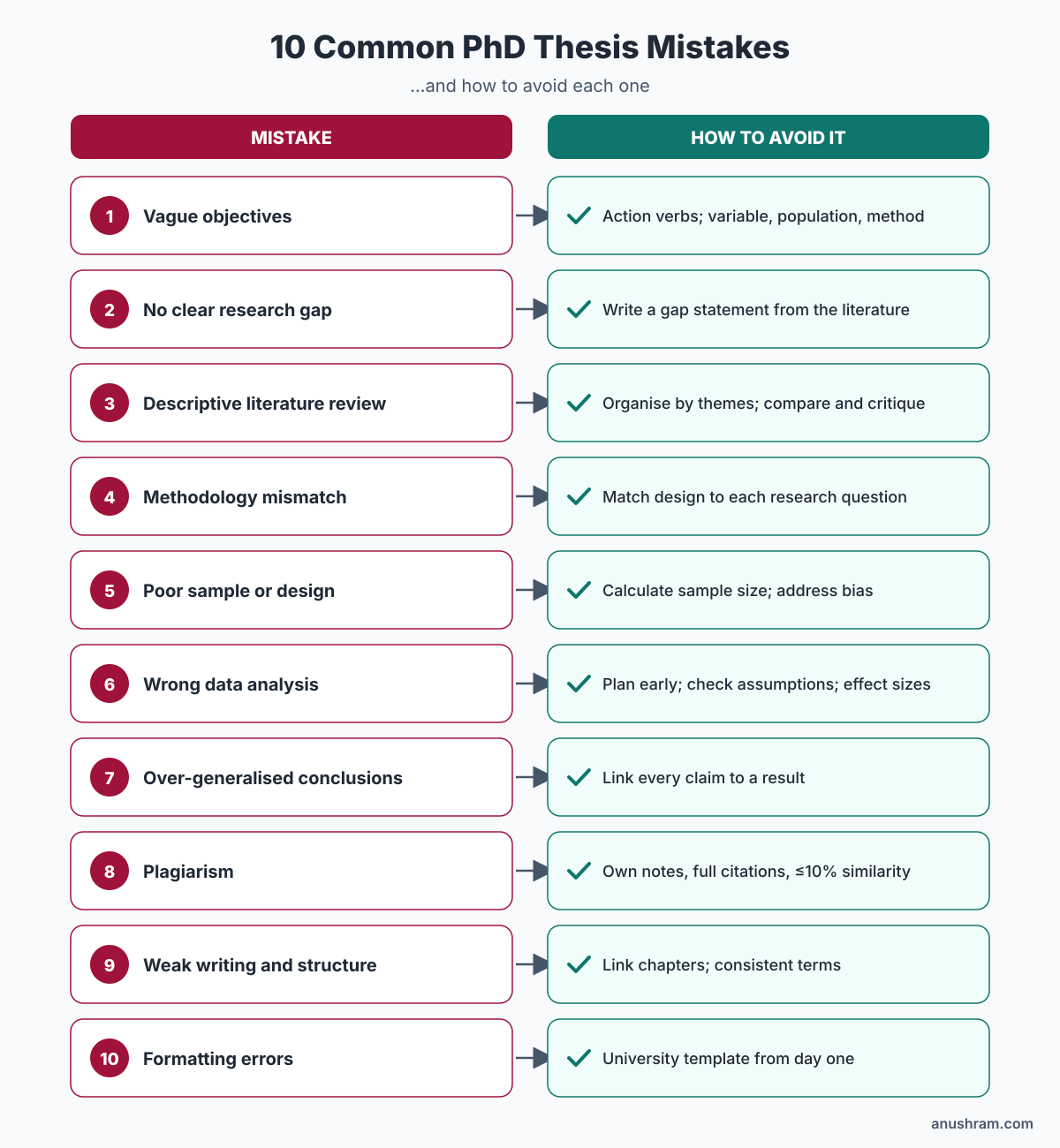
The 10 most common PhD thesis mistakes, with the fix for each.
Part 1: Mistakes in planning your research
1. Vague or unmeasurable research objectives
The mistake: Objectives such as "to study the effect of X" or "to understand Y" do not say what will be measured, in whom, or how. Examiners cannot judge whether you achieved them.
How to avoid it:
- Start each objective with an action verb: determine, compare, evaluate, develop, validate.
- Name the variable, the population and the method.
- Keep to three to five objectives, and make sure each one leads to a results chapter.
2. A weak research problem with no clear gap
The mistake: The introduction describes a topic but never states what is missing in current knowledge or why it matters. Without a clear gap, examiners ask, "What is new here?"
How to avoid it: Write a short gap statement: what previous studies have done, what remains unknown, why it matters and what your study will do. Our guide on how to identify a research gap for your PhD thesis explains the seven types of gaps and an 8-step method.
3. A literature review that summarises instead of analyses
The mistake: Paragraph after paragraph of "Author A (2019) found... Author B (2021) found..." This shows reading, not thinking.
How to avoid it:
- Organise the review by themes, not by author or year.
- Compare studies: where do they agree, disagree, or use different methods?
- End each section by stating what is still missing, building towards your research gap.
- Use a literature matrix to track populations, methods, findings and limitations.
Part 2: Mistakes in research methodology and data analysis
4. A methodology that does not match the research questions
The mistake: A question about cause and effect answered with a cross-sectional survey, or a question about experiences answered only with numbers. The design cannot answer the question being asked.
How to avoid it: For each objective, write down the design, data, sample and analysis that will answer it, and check that they fit. Justify every choice in the methodology chapter: why this design and not another?
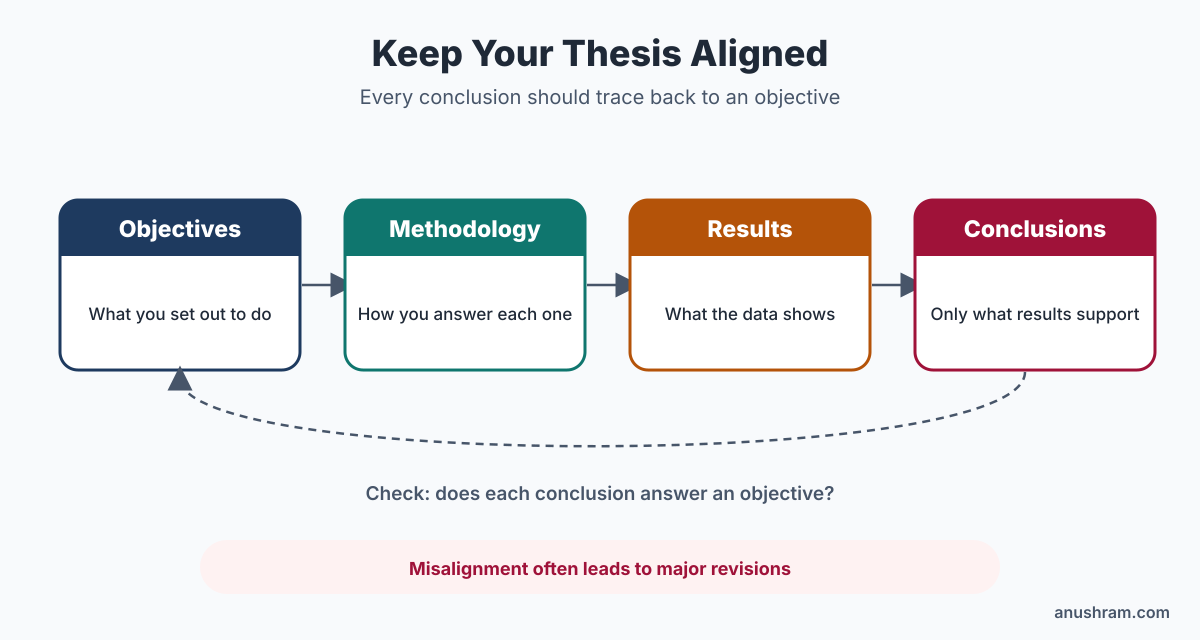
A strong thesis keeps objectives, methods, results and conclusions aligned.
5. Inadequate sample size or poor research design
The mistake: A sample chosen for convenience, with no calculation and no discussion of bias. Results may be unreliable and impossible to generalise.
How to avoid it: Calculate the sample size before data collection and report how you did it. Describe inclusion and exclusion criteria, the sampling method and how you controlled for bias. If your sample is small, say so honestly in the limitations.
6. Wrong or unexplained data analysis
The mistake: Using a statistical test because it is familiar rather than appropriate, ignoring its assumptions, or reporting p-values without effect sizes and confidence intervals.
How to avoid it:
- Plan your analysis at the synopsis stage, not after data collection.
- Check test assumptions (normality, independence, equal variance) and report them.
- Report effect sizes and confidence intervals, not just "significant" or "not significant".
- Make sure you can explain every test in your viva.
Unsure whether your methodology or statistics will satisfy examiners? Get a mentor to review them before submission. Book a free consultation →
7. Conclusions that go beyond the data
The mistake: Claiming your findings "prove" something, apply to all populations, or solve a wider problem your study never tested. Unsupported, over-generalised conclusions are among the problems examiners comment on most.[1]
How to avoid it: Link every conclusion to a specific result. Use careful language ("suggests", "is associated with") where appropriate. Include a clear limitations section and realistic suggestions for future research.
Part 3: Mistakes in academic writing and formatting
8. Plagiarism and poor citation practice
The mistake: Copying phrases from papers, paraphrasing too closely or forgetting citations. Under the UGC plagiarism regulations of 2018, similarity up to 10% carries no penalty, but above 10% to 40% means revising the thesis within six months, and higher levels bring stricter penalties, up to cancellation of registration above 60%.[3]
How to avoid it: Write from your own notes, cite every idea that is not yours, use a reference manager such as Zotero or Mendeley, and run a similarity check after each chapter. Our synopsis to defence roadmap covers the UGC plagiarism levels in detail.
9. Weak academic writing and a disconnected structure
The mistake: Long, unclear sentences, inconsistent terms, and chapters that read like separate reports. Examiners struggle to follow the argument.
How to avoid it:
- Begin each chapter with a short introduction and end it with a summary that links to the next chapter.
- Use the same terms throughout. Define them once and keep to them.
- Make sure every question raised in the introduction is answered in the conclusion.
- Prefer short, clear sentences and the active voice where your field allows it.
10. Ignoring thesis formatting guidelines
The mistake: Wrong margins, inconsistent fonts, unnumbered figures and a reference list in three different styles. Some universities return theses for formatting alone, and sloppiness affects how examiners judge the whole work.[2]
How to avoid it: Download your university's thesis template on day one and write directly into it. Use automatic numbering for headings, figures, tables and references. For an example of detailed format rules, see our NIT Durgapur thesis format guide.
Quick summary: mistakes and fixes
| Mistake | How to avoid it |
| Vague objectives | Action verbs; name variable, population and method |
| No clear research gap | Write a gap statement backed by literature |
| Descriptive literature review | Organise by themes; compare and critique |
| Methodology mismatch | Match design to each research question |
| Poor sample or design | Calculate sample size; address bias |
| Wrong data analysis | Plan early; check assumptions; report effect sizes |
| Over-generalised conclusions | Link every claim to a result; state limitations |
| Plagiarism | Own notes, full citation, aim for 10% or less |
| Weak writing and structure | Chapter links; consistent terms; clear sentences |
| Formatting errors | Use the university template from day one |
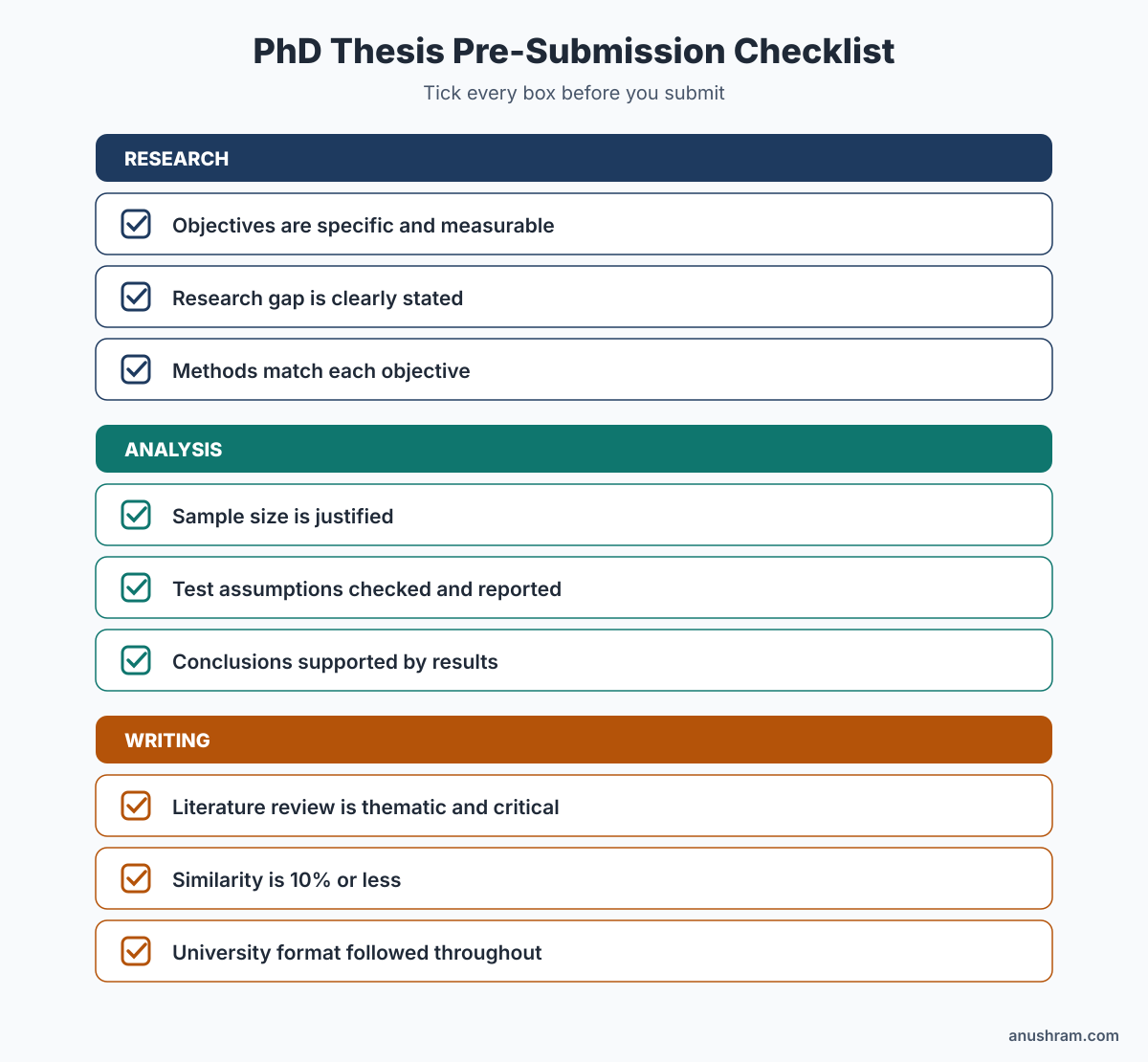
Run this checklist before you submit your thesis.
Frequently asked questions
Q1. What is the most common mistake in a PhD thesis?
Weak alignment between objectives, methodology and conclusions is one of the most common problems. When the methods cannot answer the objectives, or the conclusions go beyond the results, examiners usually ask for major revisions.
Q2. How can I avoid plagiarism in my PhD thesis?
Write from your own notes, cite every source, use a reference manager and run a similarity check after each chapter. Under UGC rules, aim for 10% similarity or less.
Q3. How do I improve the literature review in my thesis?
Organise it by themes rather than by authors, compare and critique studies, and end each section by showing what is still unknown, leading to your research gap.
Q4. Does formatting really matter in a PhD thesis?
Yes. Research on examiners shows that typos, missing references and poor formatting create a negative impression, and some universities return theses that do not follow their format rules.
Conclusion
A PhD thesis is judged not only on what you discovered but on how clearly and carefully you present it. Vague objectives, mismatched methods, descriptive reviews, weak analysis, over-reaching conclusions, plagiarism, poor writing and sloppy formatting are all common, and all avoidable.
The best protection is early planning and regular review. Align your objectives, methods and results from the synopsis stage, write chapter by chapter, check similarity as you go, and ask someone else to read your work before submission. Small corrections made early save months of revisions later.
Submit your thesis with confidence
Anushram's research mentors help PhD scholars across India avoid these mistakes with:
- Objective and methodology review before data collection
- Statistical guidance you can explain and defend in your viva
- Literature review restructuring and research gap statements
- Language editing, formatting and similarity checks through our PhD thesis guidance
https://www.anushram.com/writing-services/thesis-assistance-phd
https://www.anushram.com/writing-services/thesis-assistance-phd
We guide you; your research stays your own.
https://www.anushram.com/writing-services/thesis-assistance-phdBook your free consultation →
Or explore research paper guidance · research training · See pricing · Call or WhatsApp: +91 96438 02216

