

The viva is the final step of your mechanical engineering PhD, and for many scholars it is the most stressful. After years of experiments, simulations and writing, everything comes down to a conversation with examiners who have read your thesis closely. The good news is that viva questions are predictable. Examiners ask about the same areas again and again: your contribution, your methods, your validation and your limitations.
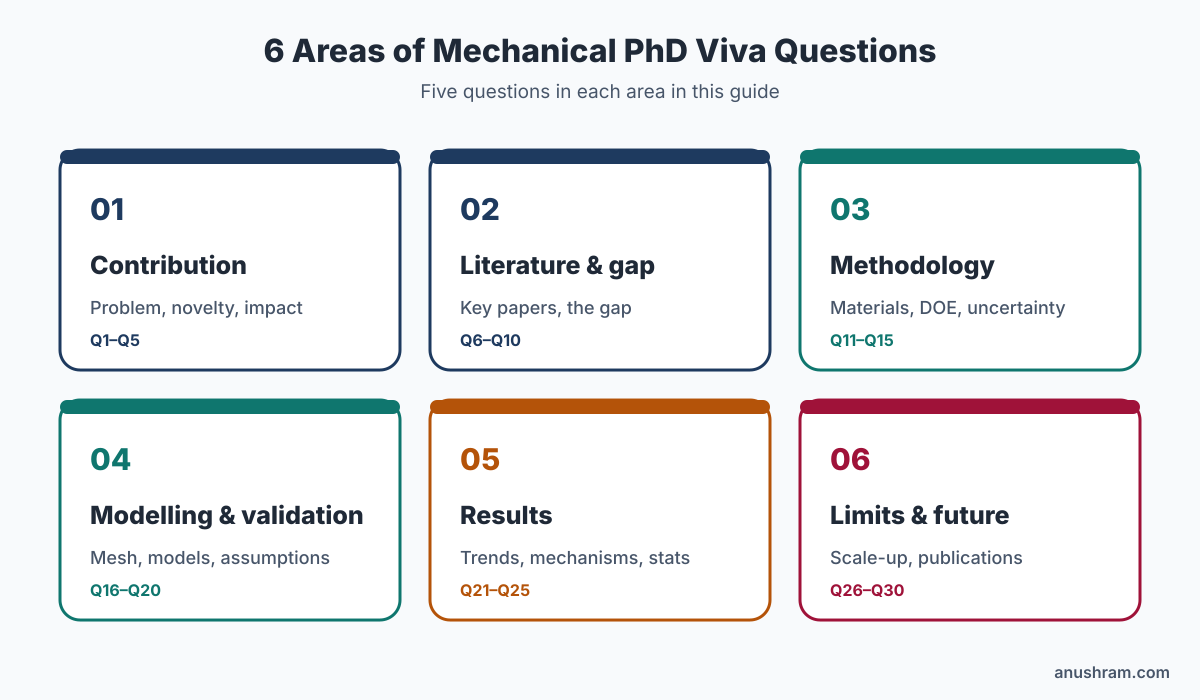
This Anushram guide gives you 30 common mechanical PhD viva questions, grouped into six areas, with guidance on how to answer each one. You will also see how the viva process works under the UGC regulations, a simple four-part answer framework, a four-week preparation plan and the mistakes to avoid on the day.
In short: prepare by area, not by memorising answers. Know your contribution in one sentence, be able to justify every methodological choice, show how you validated your results, and discuss limitations honestly. Practise aloud with a mock viva at least once before the real one.
How the PhD viva works in India
Under the UGC PhD Regulations 2022, scholars present their work and produce a draft thesis. If the evaluation of the thesis is satisfactory, the candidate defends it in a public viva voce.[1],[4] Many universities also hold a pre-submission seminar, sometimes called an open defence, before the thesis is submitted.[2] In an open defence, experts from outside the university can question the researcher on the work.[3]
The usual path from pre-submission seminar to degree. Exact steps vary by university.
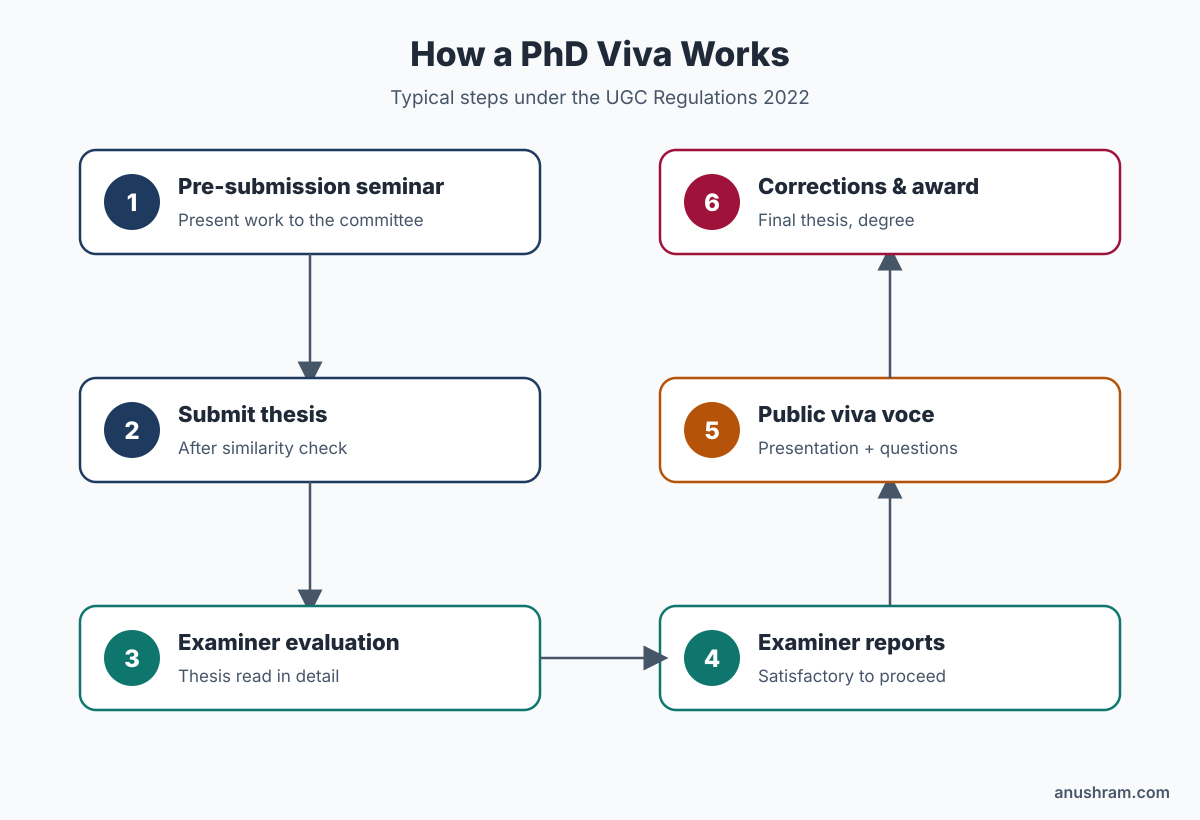
Exact procedures differ between universities, so read your university's PhD ordinance for the number of examiners, the format of the viva and the timeline for corrections. For the full journey from synopsis to defence, see our synopsis-to-defence roadmap.
What examiners are really checking
Behind every question, examiners are testing a few things:
- Ownership: did you do this work, and do you understand every part of it?
- Rigour: are your methods sound, your instruments calibrated and your models validated?
- Insight: can you explain why results behave as they do, not just what happened?
- Perspective: do you know where your work sits in the literature and where it falls short?
Keep these four aims in mind and most questions become easier to answer, because you can see what the examiner is looking for.
A simple framework for answering any question
Strong answers have a clear shape. Use this four-part framework for most technical questions:
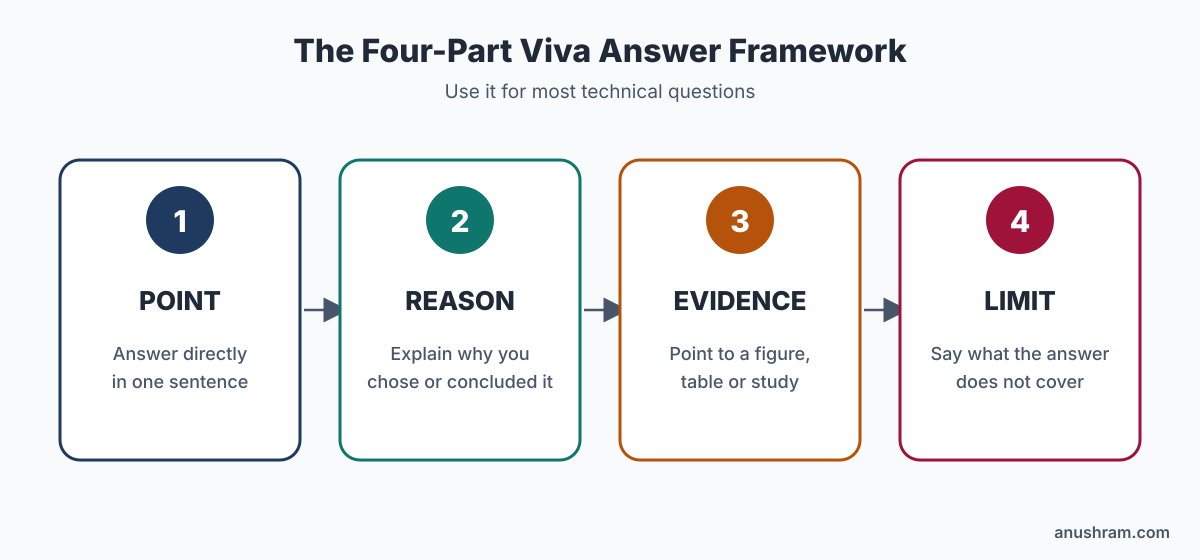
Point, reason, evidence, limit: a structure that works for most technical questions.
- Point: answer the question directly in one sentence.
- Reason: explain why you made that choice or reached that conclusion.
- Evidence: point to a figure, table, standard or published study in your thesis.
- Limit: where relevant, say what the answer does not cover. Examiners respect honesty.
Want to practise before the real viva? Book a mock viva with an Anushram mechanical engineering mentor and get written feedback on your answers and presentation. Book a mock viva →
30 mechanical PhD viva questions and how to answer them
Six areas cover almost every viva question.
1. Your research and contribution
- Summarise your thesis in two minutes. Cover the problem, the gap, your approach, the key findings and why they matter. Practise this until it is natural.
- What is your original contribution? State it in one or two sentences, and be specific: a new model, a new process window, a validated correlation or a new material combination.
- Why is this problem important? Link it to engineering practice, such as efficiency, cost, safety, emissions or reliability.
- Who will use your results? Name the industry, designers or researchers who benefit.
- If you started again, what would you do differently? Give a thoughtful answer that shows you learned something; avoid saying "nothing".
2. Literature review and research gap
- What is the research gap you addressed? Name the specific gap and the key studies that left it open.
- Which three papers influenced your work most? Know the authors, methods and findings of each.
- How is your work different from [a named study]? Compare method, conditions and results clearly and respectfully.
- Are there recent studies you have not cited? Search the literature shortly before your viva so you are up to date.
- Why did you choose this approach over alternatives? Compare options on accuracy, cost, feasibility and relevance.
3. Methodology and experiments
- Why did you choose these materials or specimens? Justify with application relevance, availability and earlier literature.
- How did you design your experiments? Explain your design of experiments (for example Taguchi, full factorial or response surface) and why it suited your factors and levels.
- How accurate were your instruments? Know the range, resolution and calibration of key instruments, and your uncertainty analysis.
- How did you ensure repeatability? Mention repeated trials, standard deviation and test standards such as ASTM or ISO methods.
- What were the main sources of error? List them honestly and explain how you reduced each one.
4. Modelling, simulation and validation
- How did you validate your numerical model? Show agreement with your experiments or published data, with the percentage difference.
- How did you choose your mesh? Present your mesh independence study and the parameter you monitored.
- Why did you choose this turbulence model, material model or element type? Justify with flow regime, material behaviour or accuracy trade-offs.
- What boundary conditions did you apply, and why? Link each one to the physical set-up.
- What assumptions did you make, and how do they affect your results? List them and estimate their impact honestly.
5. Results and interpretation
- Explain this figure. Examiners often point to a figure at random. Know what each axis, trend and outlier means.
- Why does this trend occur? Give the physical mechanism, such as heat transfer, microstructure or friction behaviour, not just the observation.
- Why do your results differ from [a published study]? Compare conditions, materials and methods to explain the difference.
- Are your results statistically significant? Refer to ANOVA, confidence intervals or regression results where you used them.
- What is your single most important finding? Quantify it, for example an improvement of a stated percentage under defined conditions.
6. Limitations, future work and publications
- What are the limitations of your work? Name two or three real limitations and their effect on how far the results can be generalised.
- How can your results be scaled up to industry? Discuss practical barriers and the next steps needed.
- What future work do you recommend? Give specific, realistic directions that build on your findings.
- Where have you published your work? Know each paper, journal and your role in it. Our guide to SCI and Scopus papers in mechanical engineering helps you plan publications.
- Did you write this thesis yourself? Sometimes asked directly. Your confident command of every chapter is the best answer. Read our guide on leading your own thesis writing.
A four-week viva preparation plan
An illustrative plan. Start earlier if your viva date allows.
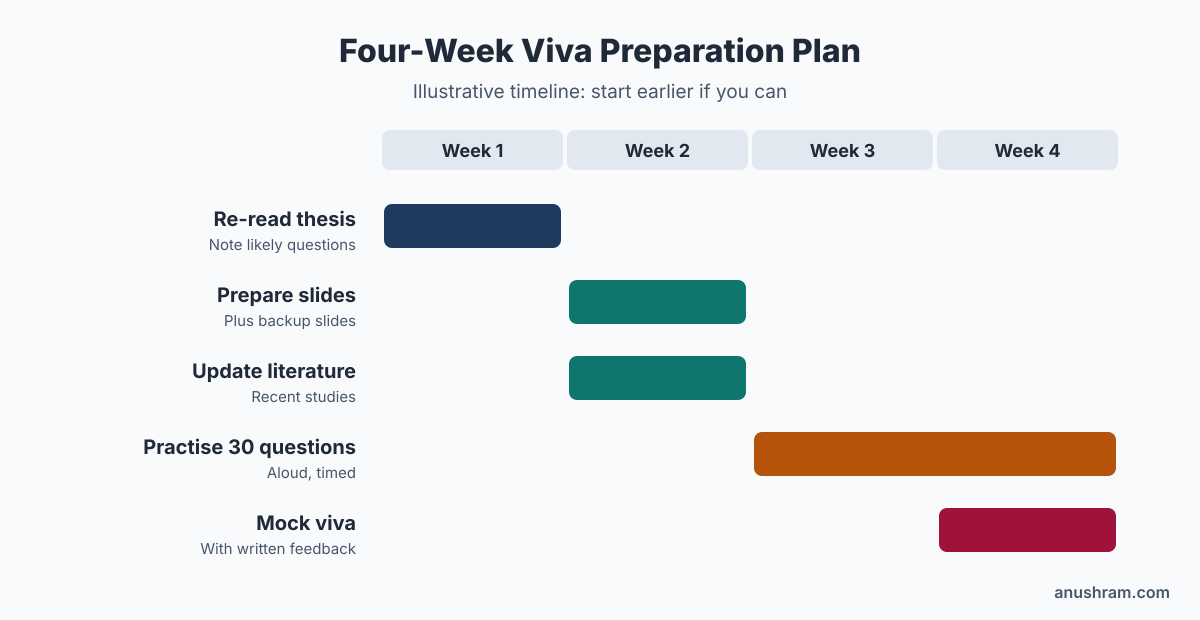
- Week 1: re-read your thesis and note likely questions for every chapter. List any errors you find.
- Week 2: prepare your presentation and update the literature with recent studies.
- Week 3: practise answering all 30 questions aloud, and prepare a short list of corrections to show the examiners if needed.
- Week 4: hold at least one mock viva, refine weak answers and rest before the day.
Presentation tips for a mechanical PhD viva
- Follow your university's time limit. Many viva presentations run for 30 to 45 minutes, so plan around one slide per minute or so.
- Lead with the problem and your contribution, not a long literature review.
- Use clear figures: set-up photographs, validation plots and key result graphs.
- Show uncertainty or error bars on experimental results.
- Keep backup slides for mesh studies, calibration and extra results, so you can answer detailed questions quickly.
Mistakes to avoid on viva day
- Defending everything. Accept valid criticism gracefully and explain how you would address it.
- Guessing. If you do not know, say so and explain how you would find out.
- Long, unfocused answers. Use the four-part framework and stop when you have answered.
- Not knowing your own figures. Every figure in your thesis is fair game.
- Arguing with examiners. Disagree respectfully with evidence, not emotion.
Many of these issues start much earlier, during writing. Our guide to common PhD thesis mistakes helps you avoid them.
How Anushram helps you prepare for the viva
- Mock viva sessions with mechanical engineering mentors, with written feedback
- A personalised list of likely questions based on your thesis
- Presentation structure and slide feedback
- Support with examiner-requested corrections through our PhD thesis assistance
- Research training to strengthen your understanding of tools such as ANSYS, MATLAB and Minitab
We prepare you to defend your own work; we never answer for you. See our pricing or read our mechanical engineering PhD thesis guidance.
Frequently asked questions
Q1. How long is a PhD viva in India?
It varies by university, but many vivas last one to two hours, including a presentation and questions. Check your university's ordinance.
Q2. Is the PhD viva open to the public?
Under the UGC PhD Regulations 2022, the thesis is defended in a public viva voce if the evaluation is satisfactory. Your university will tell you the format.
Q3. What happens if I cannot answer a question?
Say honestly that you do not know, and explain how you would find out. One unanswered question rarely decides the outcome.
Q4. What are the most common mechanical PhD viva questions?
Questions about your contribution, research gap, validation of models, experimental uncertainty, key results and limitations come up in almost every mechanical viva.
Q5. How should I prepare for viva questions?
Re-read your thesis, practise answers aloud using the point, reason, evidence and limit framework, and hold at least one mock viva.
Q6. Can I bring my thesis into the viva?
Most universities allow a copy of your thesis. Mark key pages so you can find figures quickly. Confirm the rules with your department.
Conclusion
A mechanical PhD viva is a conversation about work you know better than anyone. Prepare by area, practise the 30 questions aloud, use the four-part answer framework, and hold a mock viva before the day. If you understand your contribution, can justify your methods and discuss your limitations honestly, you will walk in prepared and walk out with confidence.
Walk into your viva prepared
Get mock viva support from an Anushram mechanical engineering mentor:
- Likely questions drawn from your own thesis
- Mock viva with realistic examiner-style questioning
- Slide and presentation feedback
- Correction support after the viva
We prepare you; you defend your own work.
Or explore PhD thesis guidance · See pricing · Call or WhatsApp: +91 96438 02216


