

A mechanical engineering PhD thesis is not just a document. It is proof that you can plan, run and defend original research on your own. Examiners test exactly that in your viva. They ask why you chose a mesh size, why one specimen failed early, or why your CFD result differs from an experiment. Only a scholar who led the work can answer those questions with confidence.
That is why Anushram works on one simple principle: you lead, we guide. This article shows what that means in practice. You will see who does what at each stage, an 8-step writing workflow, how to take part actively every week, the rules on similarity and AI tools, and how to make sure your thesis is ready for the viva.
In short: you own the research problem, data, analysis, writing and defence. Your supervisor directs the research and approves the thesis. Anushram supports you with structure, feedback, language, formatting, tools training and viva preparation, but never writes the thesis for you. This keeps your work original, defensible and fully yours.
Why the scholar must lead the thesis
There are three practical reasons, beyond ethics:
- The viva tests ownership. Examiners probe your choices and assumptions. If someone else wrote the chapters, the gaps show quickly.
- Progress is reviewed throughout the PhD. Under the UGC PhD Regulations 2022, scholars present their progress to a Research Advisory Committee and submit a brief report every semester.[2],[5] You need to understand your work at every stage, not just at the end.
- Originality is certified. Universities run every thesis through similarity software, and you and your supervisor confirm that the work is original.[1]
The 2022 regulations also removed the rule that a paper must be published before thesis submission, so many universities now set their own publication expectations.[3] Check your university's current ordinance.
Who does what: you, your supervisor and Anushram
Clear roles keep the thesis yours.
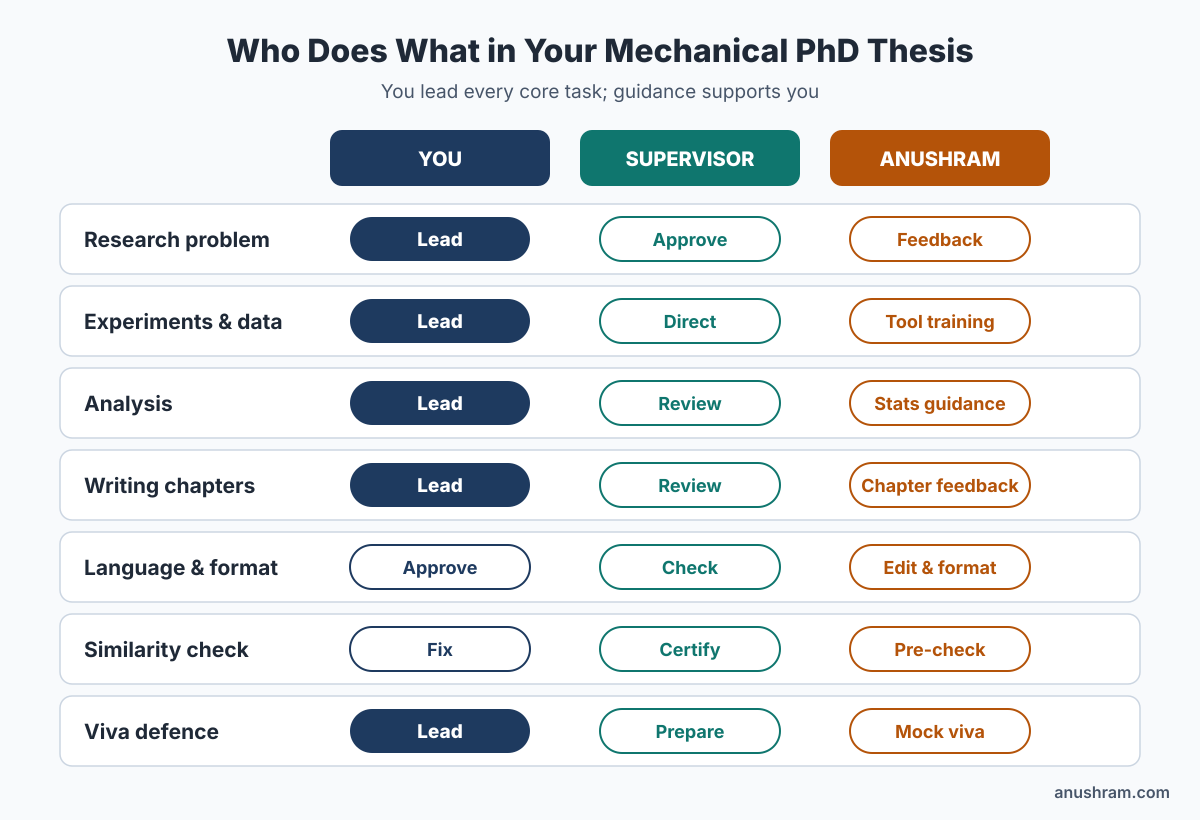
| Task | You (scholar) | Supervisor | Anushram |
| Research problem and objectives | Lead | Approve | Feedback on clarity and gap |
| Experiments, simulations and data | Lead | Direct and review | Tool training, validation advice |
| Analysis and interpretation | Lead | Review | Statistics and DOE guidance |
| Writing every chapter | Lead | Review | Structure and chapter feedback |
| Language and formatting | Final approval | Check | Editing and template formatting |
| Similarity check | Fix issues | Certify | Pre-check and guidance |
| Viva defence | Lead | Prepare you | Mock viva and question practice |
If anyone offers to take over the "Lead" column for you, walk away. That is ghostwriting, and it puts your degree at risk. Read our seven reasons scholars trust Anushram to see how we keep these boundaries.
Want a mentor who guides without taking over? Book a free thesis review with an Anushram mechanical engineering mentor and get a chapter-by-chapter feedback plan. Book your free review →
The 8-step thesis-writing workflow
Most scholars start with Chapter 1 and get stuck. A better approach is to write in the order that builds on your strongest material. Here is the workflow we recommend for mechanical PhD scholars:
Write results first, introduction last.
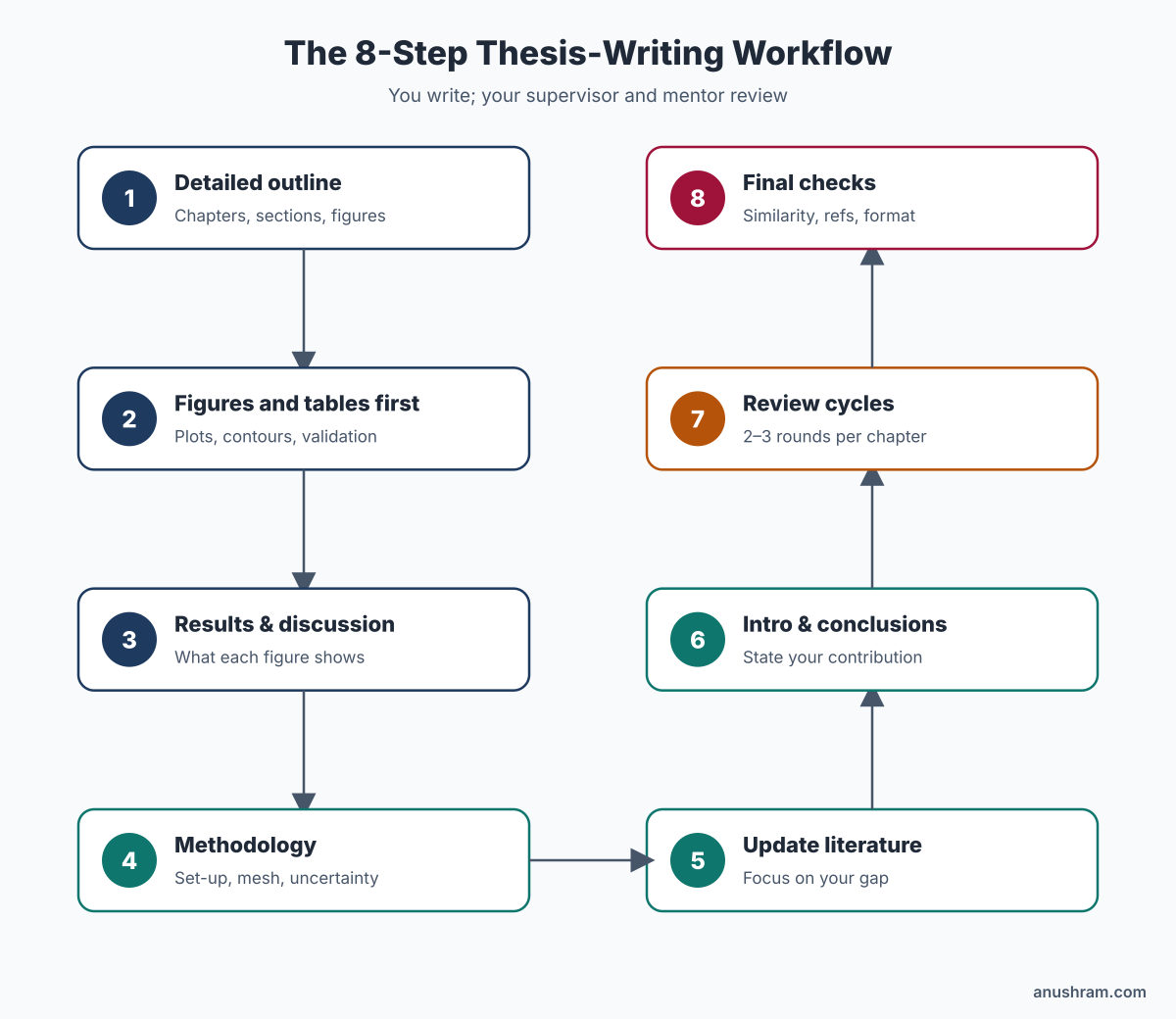
- Make a detailed outline. List every chapter, section and planned figure. Agree it with your supervisor.
- Prepare figures and tables first. In mechanical theses, the figures carry the story: stress plots, temperature contours, wear graphs and validation charts.
- Write the results and discussion chapters. Explain what each figure shows and why. Compare with published work.
- Write the methodology. Include set-ups, materials, instruments, uncertainty, mesh studies and validation in enough detail for someone to repeat your work.
- Update the literature review. Focus it on the gap your results now fill. Our guide on identifying a research gap helps here.
- Write the introduction and conclusions. Now that you know your contribution, state it clearly.
- Run review cycles. Share chapters with your supervisor and mentor, then revise. Expect two or three rounds per chapter.
- Do final checks. Similarity, references, formatting, figure numbering and the abstract.
How you take part every week
Leading your thesis means writing regularly, not in a rush before submission. A simple weekly rhythm keeps you moving and keeps the work in your own voice:
A steady weekly cycle beats a last-minute rush.
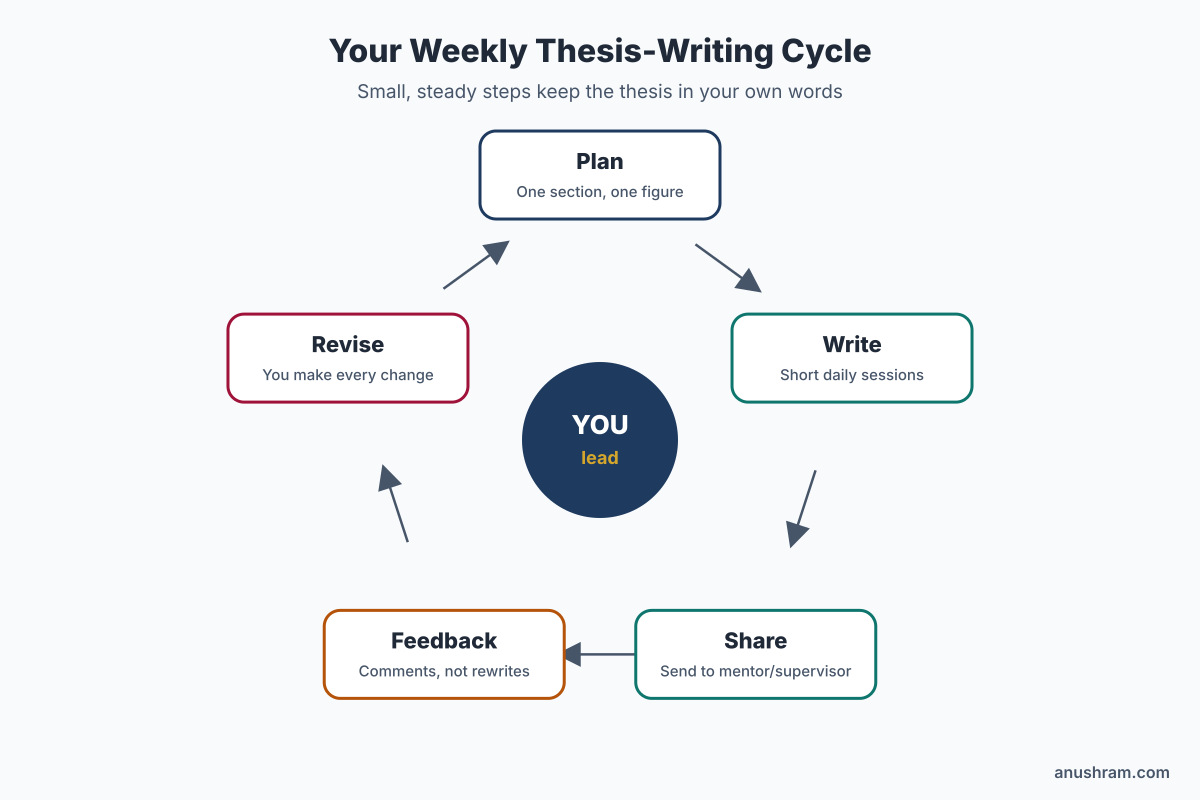
- Plan (Monday): pick one section and one figure to finish this week.
- Write (most days): short, focused sessions. Draft first, polish later.
- Share (end of week): send the section to your mentor or supervisor.
- Get feedback: written comments on structure, logic and clarity, never a rewritten chapter.
- Revise: you make the changes, so you understand every sentence.
Keep a research log with dates, settings, raw data locations and decisions. It makes the methodology chapter far easier and helps you answer viva questions precisely.
Similarity rules every scholar should know
Indian universities follow the UGC 2018 regulations on academic integrity. These set similarity levels for theses and dissertations, with penalties that rise at each level:
Similarity levels for theses under the UGC 2018 regulations.
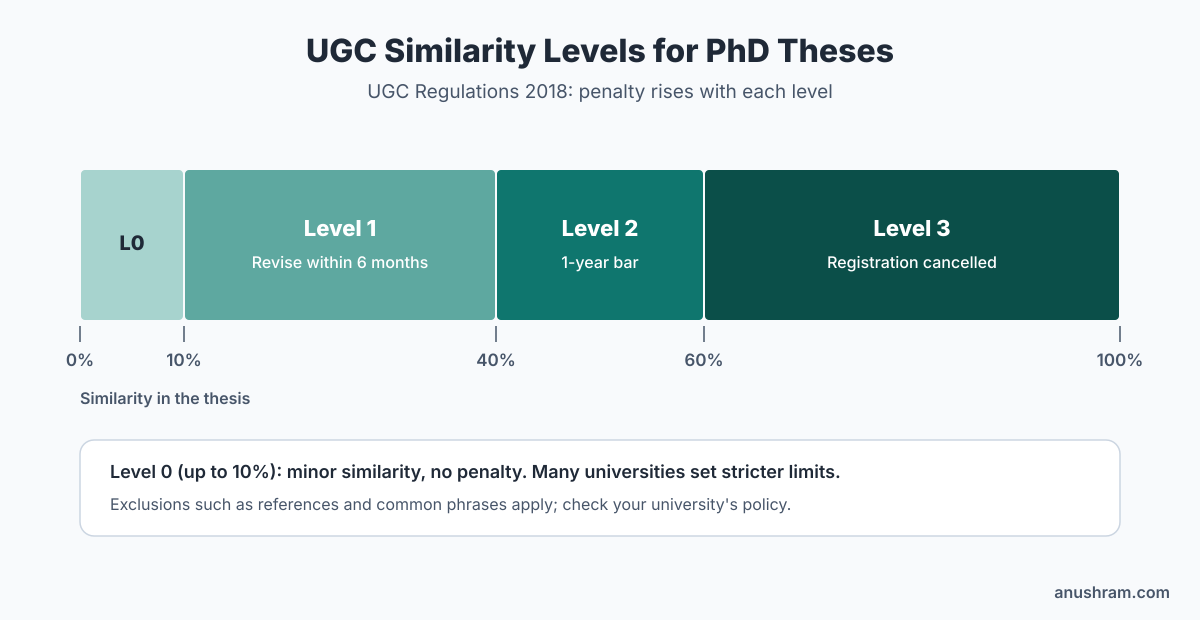
| Level | Similarity | Consequence for a thesis |
| Level 0 | Up to 10% | Minor; no penalty |
| Level 1 | Above 10% to 40% | Submit a revised script within six months |
| Level 2 | Above 40% to 60% | Barred from submitting a revised script for one year |
| Level 3 | Above 60% | Registration cancelled |
Source: UGC (Promotion of Academic Integrity and Prevention of Plagiarism in Higher Educational Institutions) Regulations, 2018.[1] Many universities apply stricter limits, so check yours. The best protection is simple: write in your own words from the start, and cite every source you use. Paraphrasing tools that disguise copied text are not a fix; they are misconduct.
Using AI tools responsibly
AI writing tools are now common, but they need care in a thesis. The Committee on Publication Ethics (COPE) states that AI tools cannot be authors, because they cannot take responsibility for the work, and that authors must disclose how they used them.[4] Follow these rules:
- Never use AI to generate results, data, figures or whole sections.
- If you use a tool for grammar or wording, check your university's policy and disclose it where required.
- Verify every reference yourself. AI tools can invent citations that do not exist.
- Remember that you are responsible for every sentence in your thesis.
Leading or being led? A quick self-check
| Healthy sign | Warning sign |
| You can explain every figure without notes | You see a chapter for the first time when it is "ready" |
| Feedback comes as comments you act on | Chapters come back fully rewritten |
| Your raw data and log are with you | Someone else holds your simulation files |
| Your supervisor sees regular drafts | Your supervisor sees the thesis only at the end |
| You know every reference you cite | References were added by someone else |
Chapter tips for a mechanical engineering thesis
- Introduction: state the engineering problem, why it matters to industry or society, and your specific objectives in numbered form.
- Literature review: organise by theme, not by author. End with a short table of key studies and the gap your work fills.
- Methodology: give full details of test rigs, materials, instruments and their accuracy, boundary conditions, mesh independence and the validation case.
- Results chapters: one chapter per objective works well. Open each with what was studied and close each with clear findings.
- Conclusions: answer each objective directly, quantify the main findings, and list limitations and future work honestly.
- Appendices: place calibration certificates, extra data and code listings here to keep the main chapters readable.
If parts of your thesis are already published or under review, cite those papers in the relevant chapters and follow your university's rules on reusing published material. Our explainer on Scopus vs SCI journals helps you choose where to publish your chapters.
Make your thesis viva-ready as you write
Every chapter you write is viva preparation. As you finish each one, list the three questions an examiner is most likely to ask about it, and write short answers. Typical mechanical examiner questions include how you validated a model, how you estimated uncertainty, why you chose particular parameters, and what you would do differently. Our synopsis-to-defence roadmap explains the full journey to the open defence.
How Anushram guides mechanical PhD scholars
- Chapter-by-chapter feedback on structure, argument and clarity
- Methodology, DOE, statistics and validation guidance
- Research training in ANSYS, MATLAB, Minitab and LaTeX
- Language editing and formatting to your university template through our PhD thesis assistance
- Similarity pre-checks and citation guidance
- Paper guidance for turning chapters into journal articles
- Mock viva sessions with mechanical engineering mentors
For a wider view of the mechanical PhD journey, read our mechanical engineering PhD thesis guidance and our guide to common PhD thesis mistakes. When you are ready to publish, see SCI and Scopus papers in mechanical engineering.
Frequently asked questions
Q1. Can Anushram write my mechanical PhD thesis?
No. We guide, review, edit and train, but the research and writing must be your own. This protects your degree and prepares you for the viva.
Q2. What is the best order to write a PhD thesis?
Many scholars find it easiest to prepare figures first, then write results, methodology, literature review, and finally the introduction and conclusions.
Q3. What similarity percentage is allowed in a PhD thesis in India?
Under the UGC 2018 regulations, up to 10% similarity carries no penalty. Many universities set their own limits, so check your university's rules.
Q4. Can I use ChatGPT or other AI tools for my thesis?
Only within your university's policy, and never to create data, results or whole sections. Disclose any use where required and verify every reference yourself.
Q5. Is publishing a paper mandatory before PhD thesis submission?
The UGC PhD Regulations 2022 removed the national requirement, but many universities still set their own publication rules. Check your university's ordinance.
Q6. How often should I share drafts with my supervisor?
Regularly, ideally every chapter section as you finish it. Frequent small reviews are easier than one large review at the end.
Conclusion
A strong mechanical PhD thesis comes from a scholar who leads the work: who designs the experiments, understands every result, writes every chapter and can defend every choice. Good guidance makes that easier, not unnecessary. Use the responsibility table, follow the 8-step workflow, write a little every week, stay within the similarity and AI rules, and prepare for the viva as you write. That is how you finish with a thesis that is truly yours.
Lead your thesis with the right guidance
Get a free thesis review from an Anushram mechanical engineering mentor:
- Chapter feedback plan based on your current draft
- Methodology and validation advice
- Similarity and formatting pre-checks
- Mock viva practice before your defence
We guide you; your thesis stays your own.
Book your free thesis review →
Or explore PhD thesis guidance · See pricing · Call or WhatsApp: +91 96438 02216

