

For a mechanical engineering PhD scholar, papers in Scopus-indexed and IEEE journals do more than satisfy a university rule. They show that your work has passed independent peer review, they make your thesis stronger in the viva, and they matter for faculty jobs, postdoc positions and research grants. Yet many scholars publish late, in a rush, and in whichever journal accepts them first.
This Anushram guide shows you a better way: a publication strategy that runs alongside your PhD. You will learn how to plan papers from your thesis chapters, when to publish each one, how to choose between Scopus-indexed and IEEE journals, the full process from submission to acceptance, how to handle reviewers, and the ethical lines you must not cross.
In short: plan three or four papers from your thesis, each with a distinct contribution. Publish the first one by the middle of your PhD. Choose journals by scope first, then indexing and metrics. Use IEEE journals when your work involves mechatronics, robotics, sensors, control or electric vehicles, and Scopus-indexed mechanical journals for core thermal, design, manufacturing and materials work.
Why a publication strategy matters
The UGC PhD Regulations 2022 removed the national requirement to publish before submitting a thesis.[1] But many universities, funding bodies and employers still expect publications, and good papers make your thesis easier to defend. A plan helps you:
- publish steadily instead of in a final-year rush
- avoid splitting one study into many thin papers
- pick journals that match each contribution
- use reviewer feedback to improve the thesis itself
Step 1: map your thesis chapters to papers
A typical mechanical PhD thesis has three or four results chapters, and each one can usually become one strong journal paper. A review paper from your literature chapter is sometimes possible, but only if it adds real synthesis, such as a structured comparison or a clear framework, rather than a summary.
One clear contribution per paper. An illustrative mapping.
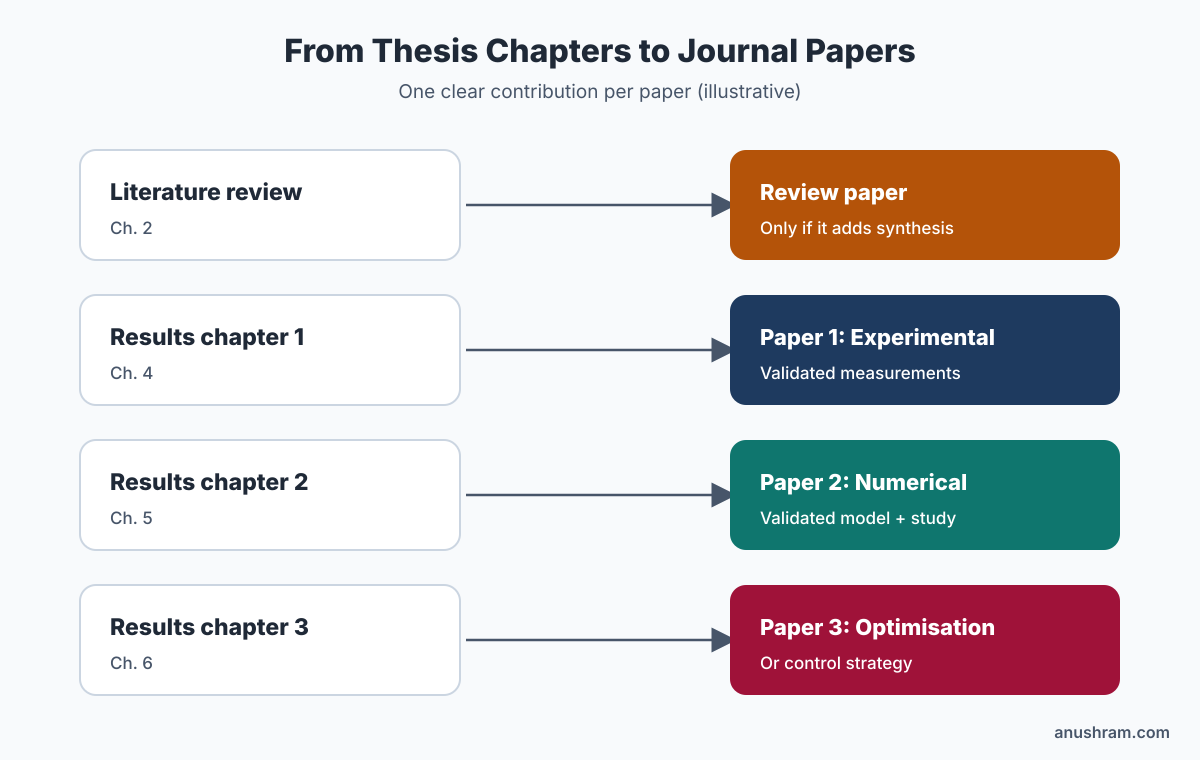
| Thesis chapter | Possible paper | Example (illustrative) |
| Literature review | Review paper, only if it adds synthesis | A structured review of cooling methods for EV battery packs |
| Results chapter 1 | Experimental paper | Effect of fin geometry on battery module temperature |
| Results chapter 2 | Numerical paper | Validated CFD model and parametric study |
| Results chapter 3 | Optimisation or control paper | Multi-objective optimisation or a smart cooling control strategy |
Each paper must answer a different question. The Committee on Publication Ethics (COPE) treats salami slicing, dividing one study into the smallest publishable units, as a form of redundant publication.[2] If two papers share data, say so in both and cite the earlier one.
Step 2: plan when to publish
An illustrative timeline. Adjust it to your programme length.
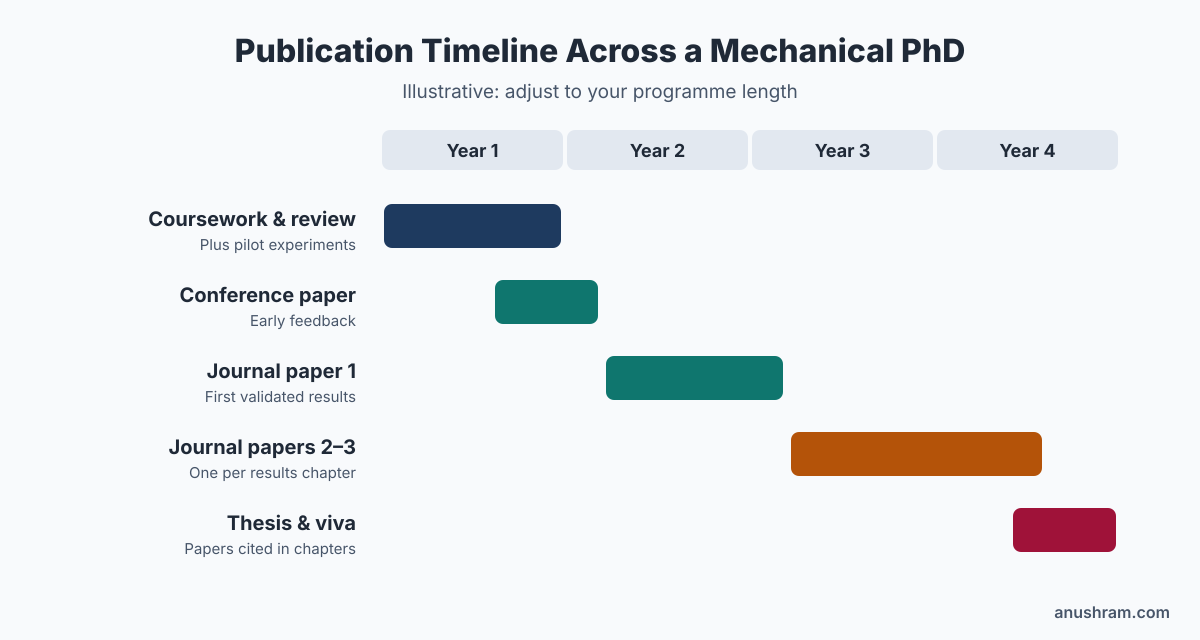
- Year 1: coursework, literature review and pilot experiments. Consider a conference paper to get early feedback.
- Year 2: submit your first journal paper from your first set of validated results.
- Years 3 to 4: submit the second and third papers as each results chapter is completed.
- Final stage: submit your thesis with published or under-review papers cited in the relevant chapters.
Journal review often takes several months, and revisions add more. Starting early means your papers are published, not just submitted, by the time of your viva.
Step 3: choose Scopus-indexed or IEEE journals
Scopus is a citation index that covers journals from many publishers, including IEEE. IEEE is a publisher. So the question is not "Scopus or IEEE?" but "Which journal fits this paper?" For a full comparison, read our guide on Scopus vs IEEE Xplore for mechanical PhDs.
| Your paper's topic | Natural home |
| Mechatronics, robotics, control | IEEE journals in robotics, mechatronics and automation, which are often Scopus-indexed too |
| Sensors, condition monitoring, machine learning | IEEE sensors, instrumentation or industrial electronics journals, or Scopus-indexed mechanical systems journals |
| Electric vehicles and battery thermal management | IEEE transportation electrification journals or Scopus-indexed energy and thermal journals |
| Thermal, fluids, IC engines | Scopus-indexed thermal and fluid engineering journals |
| Manufacturing, materials, tribology | Scopus-indexed manufacturing and materials journals |
| Design, FEA, vibration | Scopus-indexed mechanical design and vibration journals |
Step 4: shortlist journals the right way
Filter by scope first, then indexing, metrics, time and cost.
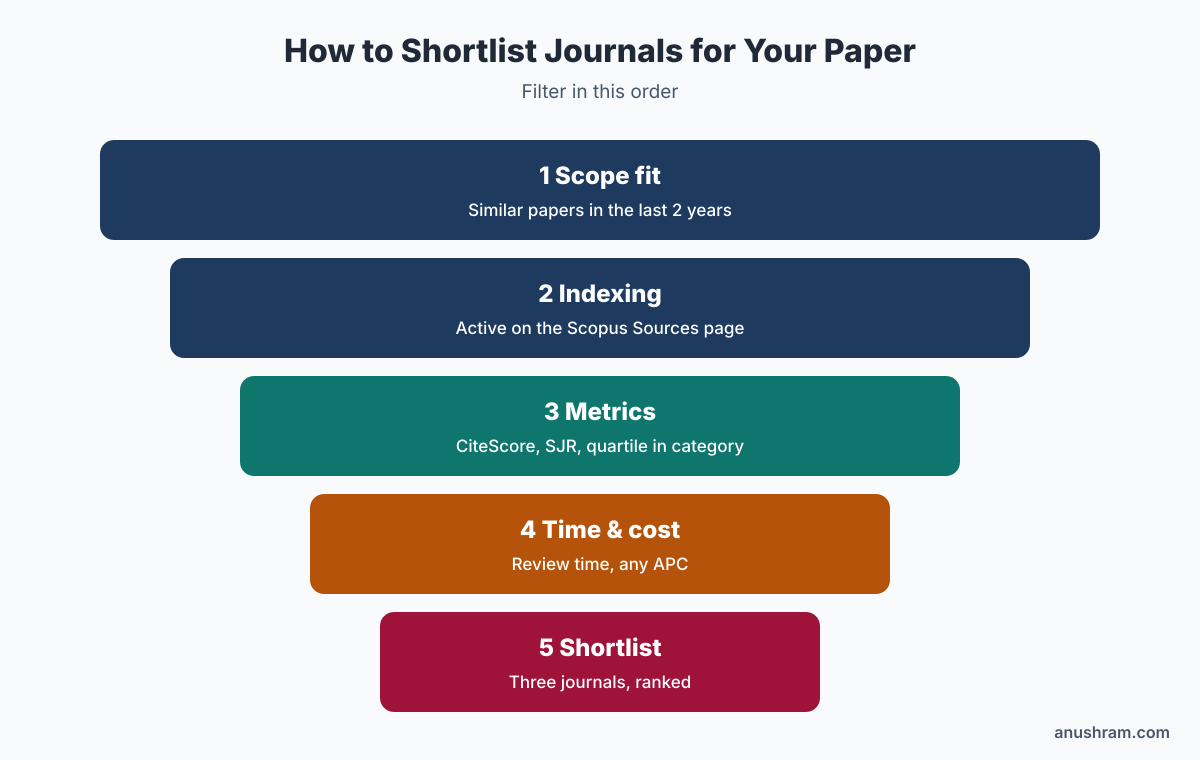
- Scope: read the aims and scope, and check that the journal has published similar work in the last two years.
- Indexing: confirm the journal is active on the free Scopus Sources page.
- Metrics: compare CiteScore, SJR and quartile within your subject category. CiteScore counts citations over a four-year window and is free to view on the Scopus Sources page.[3]
- Time and cost: check typical review times and any article processing charge. IEEE lists a charge of US$2,075 for IEEE Access, for example.[4]
- Shortlist three journals in order of preference, so a rejection does not leave you starting from scratch.
If your institution is part of India's One Nation One Subscription (ONOS) scheme, check for publishing support. Springer Nature, for example, says ONOS researchers can publish open access in 113 of its journals at no cost to them.[5] Ask your library for the current list.
Need help shortlisting journals for your mechanical PhD papers? Get a verified journal shortlist and a paper plan from an Anushram mentor. Get your free paper plan →
Write a title and abstract that pass editor screening
Editors often decide within minutes whether to send a paper for review, and they decide mostly from the title, abstract and introduction. Make these three count:
- Title: name the system, the method and the key variable, for example "Experimental and numerical study of fin pitch on air-cooled battery module temperature". Avoid vague words such as "some studies on".
- Abstract: in 200 to 250 words, give the problem, the gap, your method, two or three quantified results, and the main conclusion.
- Introduction: end with a clear paragraph stating the gap, your objectives and your contribution.
- Keywords: use terms that researchers in your area actually search for, so the paper is found after publication.
A strong title and abstract also help your paper get cited, because they are what other researchers see first in Scopus and IEEE Xplore search results.
Step 5: from submission to acceptance
The usual path of a journal paper.
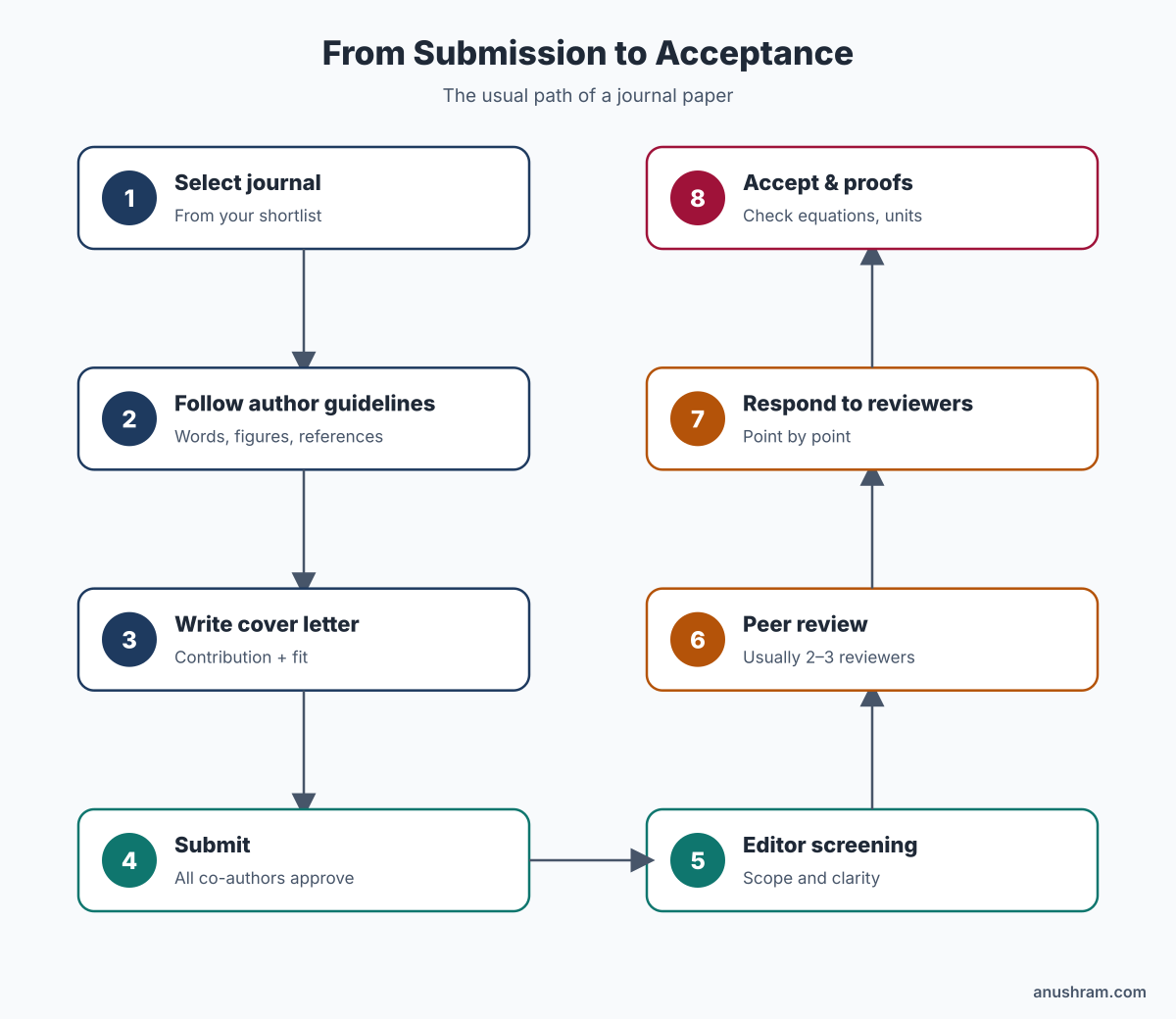
- Select the journal from your shortlist.
- Prepare to the author guidelines: word limit, figure format, reference style and data statements.
- Write a short cover letter stating the contribution and why it suits the journal.
- Submit with all co-authors' approval.
- Editor screening: many papers are rejected here for scope or clarity, so a strong abstract and introduction matter.
- Peer review: usually two or three reviewers.
- Respond to reviewers point by point.
- Acceptance and proofs: check proofs carefully, especially equations and units.
How to respond to reviewers
- Thank the reviewers, and reply to every comment in a numbered response table.
- Quote each comment, give your response, and show exactly what changed in the manuscript, with page and line numbers.
- When you disagree, explain why politely, with evidence or references.
- If a reviewer asks for extra experiments you cannot do, explain why and add it as a limitation.
- Highlight changes in the revised manuscript as the journal requests.
A rejection is not the end. Use the reviewers' comments to improve the paper, then submit to the next journal on your shortlist.
What makes a mechanical paper strong
- A clear, specific contribution stated in the abstract and introduction
- Validation: experiments compared with models, or models compared with published data
- Uncertainty: error bars, repeatability and instrument accuracy
- Physical explanation: why results behave as they do, not only what happened
- Clean figures: consistent units, readable labels and meaningful comparisons
- Honest limitations and realistic future work
These are also the qualities examiners look for in your viva. Our list of 30 mechanical PhD viva questions shows how closely they overlap.
Ethics: lines you must not cross
- No duplicate submission: never send the same paper to two journals at once.
- No salami slicing: every paper needs its own contribution.
- Honest authorship: include everyone who contributed substantially, including your supervisor, and no one who did not.
- Disclose AI use according to the journal's policy, and never use AI to create data or results.
- Avoid predatory journals that promise fast acceptance for a fee. Our guide to publishing in Scopus and SCI journals lists warning signs.
How Anushram supports mechanical PhD publications
- Thesis-to-paper planning and contribution mapping
- Journal shortlisting with indexing and metrics verified
- Structure, figure and language guidance through our research paper guidance
- Reviewer response and revision support
- Research training in ANSYS, MATLAB, Minitab and LaTeX
We guide; you author. We never guarantee acceptance or sell authorship. Read more in our Scopus and SCI publication support guide and our SCI and Scopus papers in mechanical engineering guide, or see our pricing.
Frequently asked questions
Q1. How many papers should a mechanical PhD scholar publish?
There is no national minimum under the UGC Regulations 2022, but many universities set their own rules. Three or four papers, one per results chapter, is a common and realistic target.
Q2. Are IEEE journals indexed in Scopus?
Many IEEE journals are indexed in Scopus, but check each title on the Scopus Sources page.
Q3. Can I publish thesis chapters before submitting my thesis?
Yes, in most universities. Cite the papers in the relevant chapters and follow your university's rules on using published material.
Q4. Should my supervisor be a co-author?
If your supervisor contributed to the design, interpretation or writing, they are normally a co-author. Agree the author order early.
Q5. What is a good CiteScore for a mechanical journal?
It depends on the subject category. Compare quartiles within your category rather than raw numbers across fields.
Q6. What should I do after a rejection?
Read the comments carefully, improve the paper, and submit to the next journal on your shortlist.
Conclusion
Publishing in Scopus-indexed and IEEE journals during a mechanical PhD works best with a plan. Map your chapters to distinct papers, publish the first one early, choose journals by scope before metrics, respond to reviewers carefully, and stay within ethical lines. Do this, and your papers will strengthen your thesis, your viva and your career.
Build your mechanical PhD publication plan
Get a free paper plan from an Anushram mechanical engineering mentor:
- Chapter-to-paper map with distinct contributions
- Verified journal shortlist across Scopus and IEEE
- Structure and figure guidance for each paper
- Reviewer response support through revisions
We guide you; your papers stay your own.
Or explore paper guidance · See pricing · Call or WhatsApp: +91 96438 02216


