

Looking for a research methodology question paper with answers PDF? This page gives you a complete, exam-ready paper with 65+ solved questions: 30 MCQs, 12 short answers, 5 long answers, a separate PhD coursework section, NPTEL-pattern MCQs and the most repeated previous year questions. Everything below is also available as a free PDF download.
📥 Free PDF Download: Download Research Methodology Question Paper with Answers PDF (12 pages, free)
No sign-up needed. Updated November 2026.
What's Inside This Question Paper
| Section | Questions | Marks / Use |
|---|---|---|
| Part A: Multiple choice questions | 30 | 30 × 1 = 30 |
| Part B: Short answer questions | 12 | Attempt any 8: 8 × 5 = 40 |
| Part C: Long answer questions | 5 | Attempt any 2: 2 × 15 = 30 |
| PhD coursework questions | 8 | Practice |
| NPTEL-pattern MCQs | 10 | Practice |
| Most repeated previous year questions | 15 | Self-practice |
Time: 3 hours | Maximum marks: 100. Attempt each part on your own first, then check the answers.
Part A: Research Methodology MCQs with Answers
Want more MCQ practice after this set? Try our separate research methodology MCQ with answers collection.
Q1. The main purpose of research is to:
A) Prove a personal belief
B) Generate new knowledge or validate existing knowledge
C) Collect opinions only
D) Avoid uncertainty
Answer: B) Generate new knowledge or validate existing knowledge
Q2. A hypothesis is:
A) A confirmed fact
B) A random guess
C) A testable statement about the relationship between variables
D) A summary of literature
Answer: C) A testable statement about the relationship between variables
Q3. Which of the following is a non-probability sampling method?
A) Simple random sampling
B) Stratified sampling
C) Cluster sampling
D) Convenience sampling
Answer: D) Convenience sampling
Q4. Reliability of a research instrument refers to its:
A) Accuracy
B) Consistency
C) Ethical approval
D) Sample size
Answer: B) Consistency
Q5. Validity of an instrument means:
A) It gives consistent results
B) It measures what it claims to measure
C) It has many variables
D) It has low standard deviation
Answer: B) It measures what it claims to measure
Q6. Interviews and observation are most commonly used in:
A) Qualitative research
B) Experimental physics
C) Time-series forecasting
D) Meta-analysis only
Answer: A) Qualitative research
Q7. The main purpose of a literature review is to:
A) Replace the methodology
B) Identify research gaps and build the study rationale
C) Increase page count
D) Avoid citations
Answer: B) Identify research gaps and build the study rationale
Q8. The chi-square test is generally used to test:
A) Difference between two means
B) Correlation between two continuous variables
C) Association between categorical variables
D) Trend in time-series data
Answer: C) Association between categorical variables
Q9. Plagiarism means:
A) Paraphrasing with citation
B) Using someone else's work or ideas without proper acknowledgement
C) Writing in simple English
D) Using many references
Answer: B) Using someone else's work or ideas without proper acknowledgement
Q10. Informed consent means the participant:
A) Is required to participate
B) Agrees after understanding the purpose, risks and their rights
C) Does not need to be told anything
D) Only signs for online surveys
Answer: B) Agrees after understanding the purpose, risks and their rights
Q11. Which scale of measurement has a true (absolute) zero?
A) Nominal
B) Ordinal
C) Interval
D) Ratio
Answer: D) Ratio
Q12. A five-point Likert scale item is, strictly speaking, measured on which scale?
A) Nominal
B) Ordinal
C) Ratio
D) Absolute
Answer: B) Ordinal
Q13. A Type I error occurs when the researcher:
A) Accepts a false null hypothesis
B) Rejects a true null hypothesis
C) Uses a small sample
D) Uses the wrong scale
Answer: B) Rejects a true null hypothesis
Q14. If p-value = 0.03 at a 5% level of significance, the researcher should:
A) Accept the null hypothesis
B) Reject the null hypothesis
C) Increase the sample size
D) Change the hypothesis
Answer: B) Reject the null hypothesis
Q15. To compare the means of two independent groups, the suitable test is:
A) Chi-square test
B) Independent samples t-test
C) Pearson correlation
D) Regression
Answer: B) Independent samples t-test
Q16. To compare the means of three or more groups, the suitable test is:
A) Paired t-test
B) Chi-square test
C) One-way ANOVA
D) Spearman correlation
Answer: C) One-way ANOVA
Q17. Pearson's correlation coefficient (r) measures:
A) Cause and effect
B) Linear relationship between two continuous variables
C) Difference between group means
D) Frequency of categories
Answer: B) Linear relationship between two continuous variables
Q18. The variable that the researcher manipulates in an experiment is the:
A) Dependent variable
B) Independent variable
C) Extraneous variable
D) Moderating variable
Answer: B) Independent variable
Q19. Reasoning that moves from a general theory to specific observations is:
A) Inductive
B) Deductive
C) Abductive
D) Intuitive
Answer: B) Deductive
Q20. The main purpose of a pilot study is to:
A) Publish early results
B) Test the instrument and feasibility before the main study
C) Replace the main study
D) Increase the sample size
Answer: B) Test the instrument and feasibility before the main study
Q21. Data collected first-hand by the researcher for the study is called:
A) Secondary data
B) Primary data
C) Tertiary data
D) Meta data
Answer: B) Primary data
Q22. A census means collecting data from:
A) A random sample
B) Every unit of the population
C) Only experts
D) Only secondary sources
Answer: B) Every unit of the population
Q23. A cross-sectional study collects data:
A) From the same people repeatedly over years
B) At a single point in time
C) Only from documents
D) Only through experiments
Answer: B) At a single point in time
Q24. A longitudinal study:
A) Studies different people at one time
B) Follows the same subjects over a period of time
C) Uses only secondary data
D) Has no variables
Answer: B) Follows the same subjects over a period of time
Q25. Triangulation in research means:
A) Using three samples
B) Using multiple methods or sources to cross-check findings
C) Drawing three graphs
D) Testing three hypotheses
Answer: B) Using multiple methods or sources to cross-check findings
Q26. Which of the following is NOT a referencing (citation) style?
A) APA
B) MLA
C) Chicago
D) SPSS
Answer: D) SPSS
Q27. The null hypothesis (H0) usually states that:
A) There is a significant difference
B) There is no difference or no relationship
C) The sample is biased
D) The theory is wrong
Answer: B) There is no difference or no relationship
Q28. Which measure of central tendency is most affected by extreme values?
A) Mean
B) Median
C) Mode
D) None of these
Answer: A) Mean
Q29. Snowball sampling is most useful when the population is:
A) Very large and listed
B) Hard to reach or hidden
C) Homogeneous
D) Already in a sampling frame
Answer: B) Hard to reach or hidden
Q30. Action research mainly aims to:
A) Build abstract theory only
B) Solve an immediate practical problem in a specific setting
C) Review literature
D) Replicate old studies
Answer: B) Solve an immediate practical problem in a specific setting
Part B: Short Answer Questions with Answers (5 Marks)
Q31. Define research and list any four characteristics of good research.
Answer:
- Research is a systematic and objective process of investigating a problem to generate new knowledge or validate existing knowledge.
- Characteristics (any four): systematic, empirical (based on evidence), logical, replicable, objective, ethical, and clearly documented.
Q32. Differentiate between population and sample with an example.
Answer:
- Population: the entire group the researcher is interested in (e.g., all MBA students of a university).
- Sample: a subset selected to represent the population (e.g., 200 of those MBA students).
- Samples are used because studying the whole population is usually costly, slow or impractical.
Q33. What is a research design? Mention four types.
Answer:
- Research design is the blueprint of a study: how data will be collected, measured and analysed to answer the research question.
- Types: exploratory, descriptive, explanatory (causal), experimental, cross-sectional and longitudinal (any four).
Q34. Differentiate between reliability and validity.
Answer:
- Reliability: consistency of results; the same tool under the same conditions gives similar results.
- Validity: accuracy; the tool measures what it is supposed to measure.
- A tool can be reliable but not valid (consistently wrong), but a valid tool must be reliable.
Q35. Explain null hypothesis (H0) and alternative hypothesis (H1) with an example.
Answer:
- H0: states that there is no effect, difference or relationship.
- H1: states that an effect, difference or relationship exists.
- Example: H0: There is no difference in mean scores of online and offline learners. H1: There is a difference.
Q36. Write a short note on research ethics.
Answer: Key principles: informed consent, voluntary participation, confidentiality, anonymity, no harm to participants, honesty in reporting, avoiding plagiarism and data fabrication, disclosure of conflicts of interest, and the right to withdraw.
Q37. Differentiate between basic (fundamental) and applied research.
Answer:
- Basic research aims to expand knowledge and develop theory without immediate practical use (e.g., studying how memory works).
- Applied research aims to solve a specific practical problem (e.g., improving a training programme to raise employee productivity).
Q38. What are the features of a good research problem?
Answer: Clear and specific, researchable with available data, significant (adds value), feasible in time and cost, ethical, and of genuine interest to the researcher.
Q39. Differentiate between primary and secondary data.
Answer:
- Primary data: collected first-hand for the current study (surveys, interviews, experiments, observation). Original but costly and time-consuming.
- Secondary data: already collected by others (census, reports, journals, databases). Cheap and quick but may not fit the study exactly.
Q40. Differentiate between a questionnaire and an interview schedule.
Answer:
- A questionnaire is filled in by the respondent; suitable for literate respondents and large samples; cheaper.
- An interview schedule is filled in by the interviewer who asks the questions; useful for less literate respondents; higher response rate but costlier.
Q41. Differentiate between Type I and Type II errors.
Answer:
- Type I error (alpha): rejecting a null hypothesis that is actually true (false positive).
- Type II error (beta): failing to reject a null hypothesis that is actually false (false negative).
- Reducing alpha increases the chance of beta unless the sample size is increased.
Q42. Explain the four scales of measurement.
Answer:
- Nominal: categories without order (gender, blood group).
- Ordinal: ordered categories (rank, Likert responses).
- Interval: equal intervals, no true zero (temperature in Celsius).
- Ratio: equal intervals with a true zero (income, weight, age).
Part C: Long Answer Questions with Answers (15 Marks)
Q43. Explain the steps in the research process.
Answer:
- 1. Identify the research problem - choose a clear, researchable issue.
- 2. Review the literature - understand what is known and locate gaps.
- 3. Set objectives / research questions / hypotheses.
- 4. Choose the research design - exploratory, descriptive, experimental, etc.
- 5. Plan sampling - population, sampling method and sample size.
- 6. Develop tools - questionnaire, interview schedule, scales; pilot test them.
- 7. Collect data following ethical standards.
- 8. Analyse data - statistical tests or qualitative coding.
- 9. Interpret results - link findings to objectives and literature.
- 10. Write the report - introduction, method, results, discussion, conclusion, references.
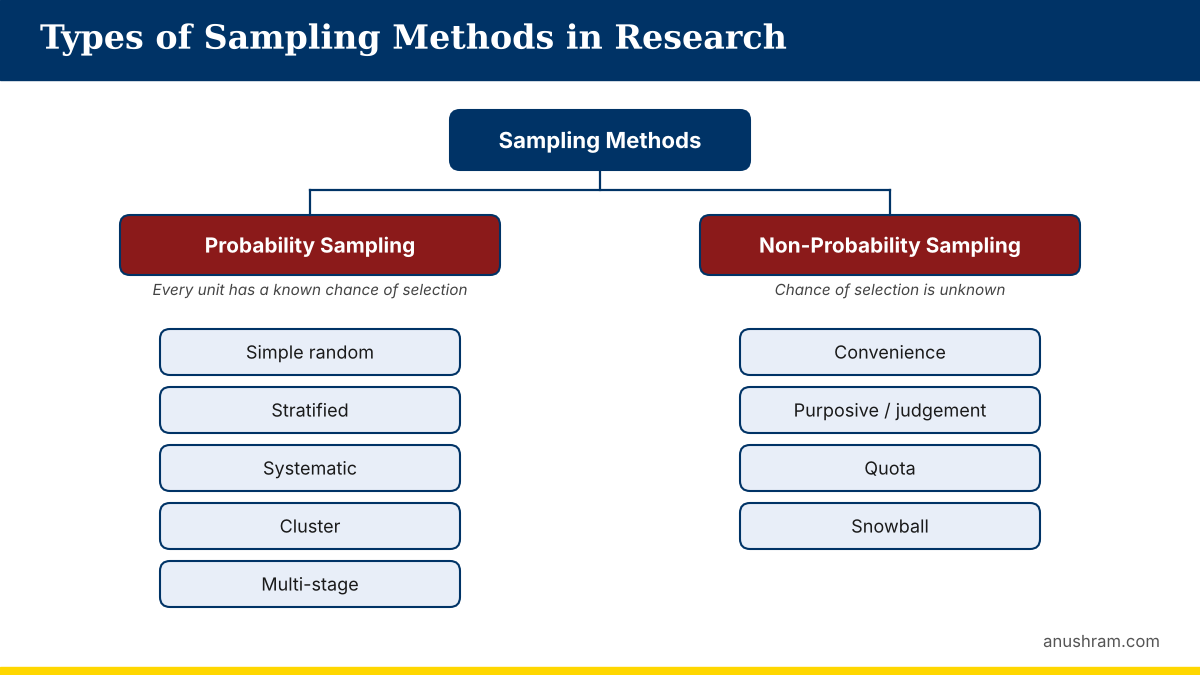
Q44. Explain probability and non-probability sampling methods with examples.
Answer:
- Sampling is selecting a subset of a population to represent it.
- A) Probability sampling (every unit has a known chance of selection): simple random (lottery method), stratified (divide into strata, then sample each), systematic (every k-th unit), cluster (randomly select whole groups), multi-stage. Example: randomly selecting 100 patient records from a hospital list.
- B) Non-probability sampling (chance of selection unknown): convenience, purposive/judgement, quota, snowball. Example: surveying the first 150 shoppers leaving a mall.
- Conclusion: probability sampling supports generalisation; non-probability sampling is faster and cheaper but more prone to bias.
Q45. Explain the procedure of hypothesis testing.
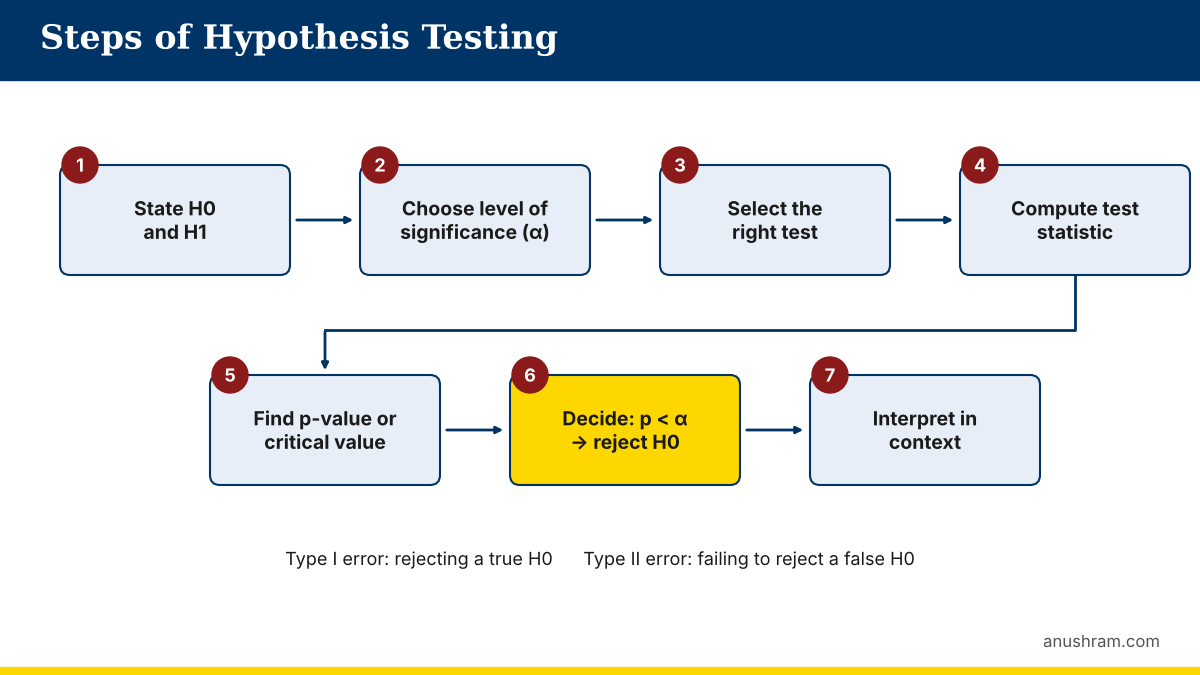
Answer:
- 1. State H0 and H1.
- 2. Choose the level of significance (usually 5% or 1%).
- 3. Select the appropriate test (t-test, ANOVA, chi-square, correlation, etc.) based on data type and design.
- 4. Compute the test statistic from sample data.
- 5. Find the p-value or critical value.
- 6. Decide: if p < alpha, reject H0; otherwise fail to reject H0.
- 7. Interpret the result in the context of the research question, noting possible Type I/II errors.
Q46. Discuss the various methods of data collection.
Answer:
- Primary methods: survey/questionnaire, structured and unstructured interviews, focus group discussions, observation (participant and non-participant), experiments, case studies.
- Secondary sources: government publications, census, company reports, journals, books, online databases.
- Choice depends on: research objectives, nature of data (qualitative or quantitative), budget, time, and respondents' accessibility.
- Good practice: pilot-test tools, ensure reliability and validity, and follow ethical guidelines.
Q47. Explain the structure (layout) of a research report.
Answer:
- Preliminary pages: title page, declaration, certificate, acknowledgement, abstract, table of contents, list of tables/figures.
- Main text: introduction, review of literature, research methodology, data analysis and interpretation, findings and discussion, conclusion, limitations and suggestions.
- End matter: references/bibliography, appendices (questionnaire, raw data).
PhD Research Methodology Question Paper with Answers (Coursework)
PhD coursework papers go beyond basic definitions. Expect questions on research gaps, synopsis writing, plagiarism rules and research ethics. These are the questions PhD scholars most often face. For a longer list, see important research methodology questions for PhD coursework.
Q48. What is a research gap? How do you identify it?
Answer:
- A research gap is a question or area that existing literature has not answered or has answered inadequately.
- Identify it by reviewing recent papers (last 5-7 years), reading 'limitations' and 'future research' sections, comparing contexts (country, sector, population), and checking for contradictory findings or outdated methods.
Tip: Shodhganga is a good place to see which topics have already been studied. Here is how to search, download and cite Shodhganga theses.
Q49. What are the components of a good problem statement?
Answer: Context of the problem, what is currently known, the gap or issue, why it matters (significance), who is affected, and what the study will do about it - usually in 150-300 words.
Q50. Differentiate between a systematic literature review and a narrative review.
Answer:
- A systematic review follows a pre-defined protocol, explicit search strategy, inclusion/exclusion criteria and quality assessment (often reported with PRISMA). It is reproducible.
- A narrative review summarises literature selectively based on the author's judgement; it is flexible but more prone to bias.
Q51. Explain the levels of plagiarism under the UGC (Promotion of Academic Integrity and Prevention of Plagiarism) Regulations, 2018.
Answer:
- Similarity up to 10% - Level 0 (minor, no penalty).
- Above 10% to 40% - Level 1.
- Above 40% to 60% - Level 2.
- Above 60% - Level 3 (most serious).
- Penalties increase with level, for both students and faculty. Core areas of work (results, analysis, conclusions) are expected to be original.
Q52. What is the Research and Publication Ethics (RPE) course?
Answer: RPE is a 2-credit course made mandatory by UGC for PhD coursework. It covers philosophy and ethics, scientific misconduct (falsification, fabrication, plagiarism), publication ethics, open access publishing, identifying predatory journals, databases and research metrics (impact factor, h-index).
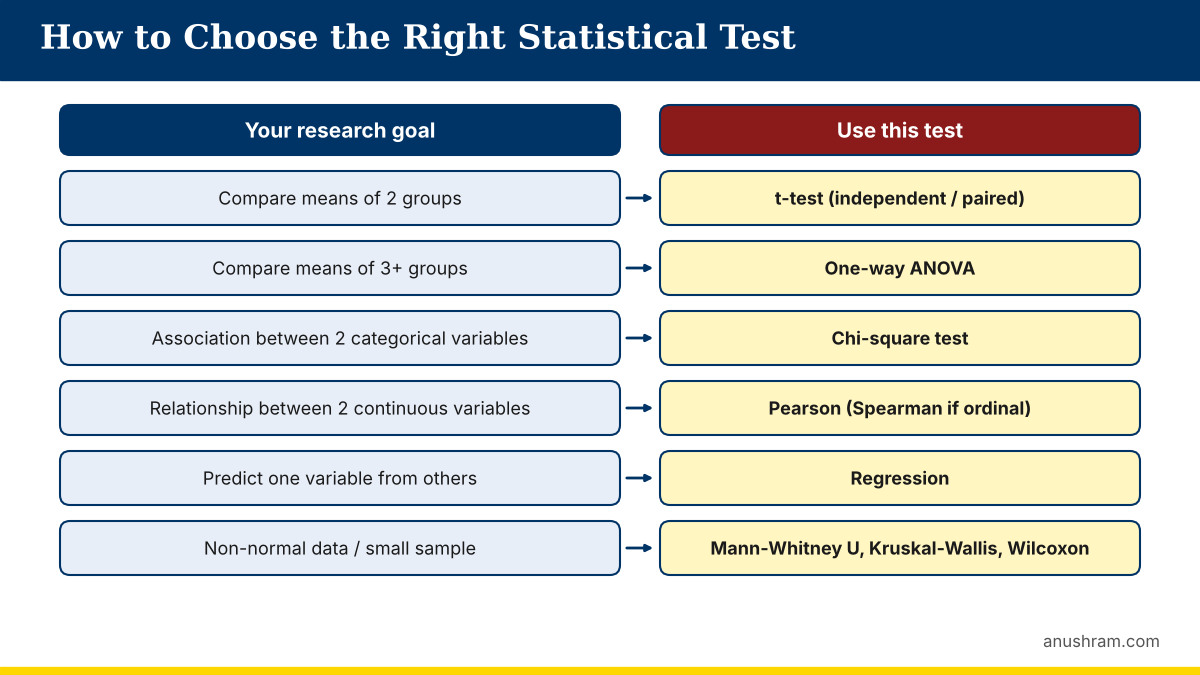
Q53. How do you choose the right statistical test for your data?
Answer:
- Compare 2 group means: t-test (independent or paired).
- Compare 3+ group means: ANOVA.
- Association between two categorical variables: chi-square.
- Relationship between two continuous variables: Pearson (or Spearman for ordinal/non-normal data).
- Predict one variable from others: regression.
- Non-normal data or small samples: non-parametric tests (Mann-Whitney U, Kruskal-Wallis, Wilcoxon).
Q54. What should a PhD synopsis contain?
Answer: Title, introduction and background, review of literature, research gap, problem statement, objectives, hypotheses (if any), research methodology (design, sample, tools, analysis plan), scope and limitations, expected contribution, tentative chapter plan, timeline, and references.
Step-by-step guidance: how to write a PhD synopsis that gets approved.
Q55. What are predatory journals and how do you avoid them?
Answer:
- Predatory journals charge publication fees but provide little or no genuine peer review or editorial service.
- Warning signs: guaranteed or very fast acceptance, aggressive email invitations, fake or misleading indexing claims, unclear editorial board.
- Avoid them by verifying indexing directly on Scopus or Web of Science, checking your university's approved journal list, and asking your supervisor.
If you are working on your synopsis or thesis right now, our PhD thesis and synopsis support team can review your research gap and methodology.
NPTEL Research Methodology Questions with Answers (Practice MCQs)
NPTEL's research methodology courses test concepts through weekly assignments and a final proctored exam. The official assignments are published on each course page at onlinecourses.nptel.ac.in. The MCQs below follow the same conceptual style, so you can practise before attempting the official ones. For week-wise NPTEL papers, see our NPTEL research methodology previous year question papers guide.
Q56. Converting an abstract concept into something measurable is called:
A) Conceptualisation
B) Operationalisation
C) Generalisation
D) Triangulation
Answer: B) Operationalisation
Q57. A list of all units from which a sample is drawn is called the:
A) Sampling error
B) Sampling frame
C) Sampling unit
D) Sampling bias
Answer: B) Sampling frame
Q58. A variable that influences both the independent and dependent variable, distorting results, is a:
A) Confounding variable
B) Dependent variable
C) Control group
D) Constant
Answer: A) Confounding variable
Q59. Cronbach's alpha is used to assess:
A) Sample size
B) Internal consistency reliability
C) Normality of data
D) Content validity
Answer: B) Internal consistency reliability
Q60. Expert judgement on whether a test covers all aspects of a construct relates to:
A) Content validity
B) Test-retest reliability
C) Statistical power
D) Random sampling
Answer: A) Content validity
Q61. Random assignment of participants to groups mainly helps to:
A) Increase sample size
B) Reduce selection bias and control confounders
C) Avoid ethics approval
D) Speed up data collection
Answer: B) Reduce selection bias and control confounders
Q62. IMRaD, the common structure of research papers, stands for:
A) Introduction, Methods, Results and Discussion
B) Index, Method, Review and Data
C) Introduction, Model, Review and Design
D) Idea, Method, Report and Data
Answer: A) Introduction, Methods, Results and Discussion
Q63. A researcher's h-index of 10 means:
A) 10 papers in total
B) 10 papers each cited at least 10 times
C) 10 citations in total
D) 10 co-authors
Answer: B) 10 papers each cited at least 10 times
Q64. Journal Impact Factor is based on:
A) Number of authors
B) Average citations to articles the journal published in the previous two years
C) Number of issues per year
D) Acceptance rate
Answer: B) Average citations to articles the journal published in the previous two years
Q65. Which is an example of a falsifiable hypothesis?
A) Some things are unknowable
B) Students who sleep 8 hours score higher than those who sleep 5 hours
C) Research is important
D) Everything happens for a reason
Answer: B) Students who sleep 8 hours score higher than those who sleep 5 hours
Research Methodology Previous Year Question Paper: Most Repeated Questions
These questions appear again and again in university previous year papers (BBA, MBA, M.Com, M.Ed, MSW and PhD coursework). Most are answered in Parts B and C above. Use them for timed self-practice, and check the solved previous year papers guide for model answers.
- Define research. Explain the types and objectives of research.
- What is a research problem? Explain the steps in formulating a research problem.
- Explain the significance of literature review in research.
- What is research design? Explain the features of a good research design.
- Explain the different methods of sampling. What are sampling and non-sampling errors?
- What is a hypothesis? Explain its types and the procedure of hypothesis testing.
- Distinguish between primary and secondary data. Explain the methods of collecting primary data.
- What is a questionnaire? Explain the essentials of a good questionnaire.
- Explain the scales of measurement with examples.
- Explain reliability and validity and their types.
- Write short notes on: (a) t-test (b) chi-square test (c) ANOVA.
- Explain the steps in writing a research report.
- What is plagiarism? How can it be avoided?
- Explain the role of computers and software (SPSS, Excel, R) in research.
- Discuss the ethical issues in research.
Where to find official previous year papers: your university's examination or library portal, your department's LMS (Moodle or Google Classroom), and the NPTEL course page for NPTEL assignments.
How to Use This Question Paper to Score Maximum Marks
- Attempt first, check later: write each answer in 5-7 minutes before looking at the model answer.
- Compare the structure: did you include a definition, explanation, example and diagram where needed?
- Rewrite weak answers once: fix only what you missed.
- Keep a repeat list: topics you get wrong twice are your biggest scoring gaps.
- Do one full timed paper in the last week before the exam.
Frequently Asked Questions
Can I download this research methodology question paper with answers as a PDF?
Yes. Use the download button at the top of this article to get the full paper (65+ questions with answers) as a free PDF. No sign-up needed.
Is this question paper useful for PhD coursework exams?
Yes. Besides the general paper, there is a separate PhD coursework section covering research gaps, synopsis structure, UGC plagiarism levels, Research and Publication Ethics (RPE) and choosing statistical tests.
Where can I find NPTEL Research Methodology previous year question papers?
NPTEL publishes weekly assignments for its courses on the course page at onlinecourses.nptel.ac.in. The NPTEL-pattern MCQs in this article help you practise the same style of conceptual questions.
Which topics repeat most often in research methodology exams?
Research process, research design, sampling, hypothesis testing, reliability and validity, data collection methods, scales of measurement, research ethics and report writing.
How many question papers should I practise before the exam?
Five to seven well-attempted papers are usually enough. Attempt each one under timed conditions, then compare your answers with the model answers.
Are previous year question papers enough to pass?
They show you the pattern and the repeated questions, but pair them with a paper that has model answers so you also learn how to structure your answers.
Is research methodology a scoring subject?
Yes, if you practise structured answers. Most questions follow a definition-explanation-example format, so well-organised answers score well.
Conclusion
A solved question paper is the fastest way to prepare for research methodology because it trains both your concepts and your answer-writing style. Download the PDF, attempt it under timed conditions, and revise the repeated topics: research design, sampling, hypothesis testing, reliability and validity, data collection and research ethics.
📥 Download the full Research Methodology Question Paper with Answers PDF
Call / WhatsApp: +91 96438 02216
Visit: https://www.anushram.com


